

Every year, our export team fields dozens of questions from distributors who have been burned by fake CE documents from other suppliers authentic CE certifications 1. The problem is real. One European importer we spoke with lost over €400,000 when customs seized an entire container of electric wheelchairs bearing fraudulent CE marks.
To verify authentic CE certifications for Chinese electric wheelchairs, cross-check the Notified Body’s four-digit number on the EU NANDO database, request the full Technical File and Declaration of Conformity referencing MDR 2017/745, validate ISO 13485 via IAF CertSearch, and physically inspect the CE mark on the product itself.
This guide walks you through each verification step in detail. We will cover database checks, document requests, red flags, and legal protections so you can source with confidence. Let’s start from the beginning.
How can I verify if a Chinese electric wheelchair manufacturer's CE certificate is actually valid?
In our experience exporting electric wheelchairs to over 15 countries, we have seen firsthand how confusing the CE landscape can be for buyers. Many suppliers show a PDF with a CE logo, but that alone proves nothing.
Verify a Chinese manufacturer's CE certificate by confirming the four-digit Notified Body number on the EU NANDO database, matching the certificate's product model and scope to the actual wheelchair, and contacting the Notified Body directly to confirm issuance and validity dates.
Start With the Notified Body Number
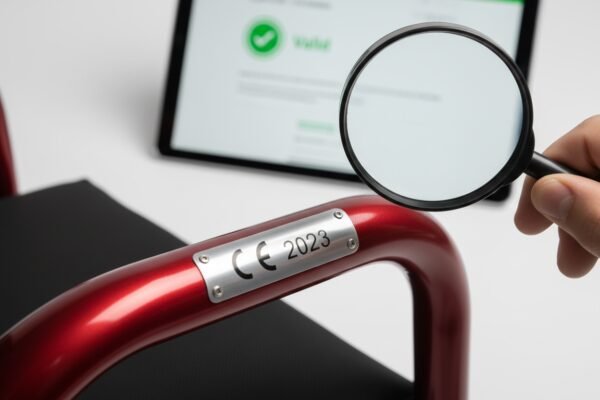
Every legitimate CE certificate for a Class IIa medical device like an electric wheelchair must involve a Notified Body. This body is assigned a unique four-digit identification number by the European Commission. Notified Body's four-digit number 2 You can find this number printed on the CE mark itself and on the certificate.
Go to the NANDO database (ec.europa.eu/growth/tools-databases/nando). Type in the four-digit number. The database will show you the body's name, country, and the exact directives and regulations it is authorized to certify. If the number does not appear, or if the body is not authorized for MDR 2017/745 3 or the relevant Machinery Directive, the certificate is fake.
Match the Certificate to the Product
A common trick is using a valid certificate for one product and presenting it for another. When our quality team prepares documentation, every certificate lists the exact product model, series number, and scope. You must check that the wheelchair model you are purchasing matches exactly what is written on the certificate.
Contact the Notified Body Directly
Most reputable Notified Bodies like TÜV, SGS, Intertek, and BSI have online certificate verification portals. You can enter the certificate number and instantly see if it is active. If the body does not offer an online portal, send them an email with the certificate number and ask for confirmation. This takes 2–5 business days and is one of the most reliable checks.
Physical CE Mark Inspection
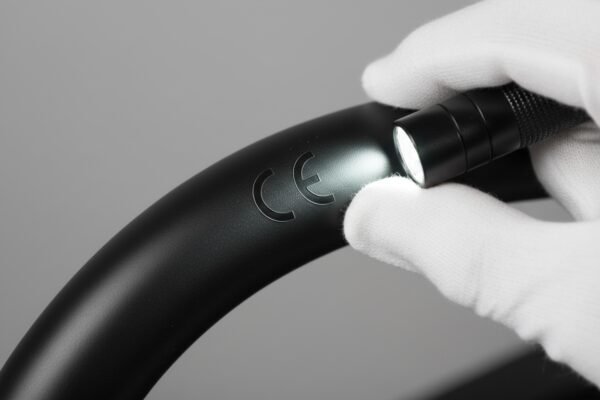
When you receive samples, inspect the CE mark on the product. A legitimate mark is typically embossed or engraved into the frame or nameplate. Sticker-only CE marks are a red flag. Also check the proportions of the letters. The official CE mark has specific geometric spacing. The fraudulent "China Export" mark looks similar but the letters are closer together.
| Verification Step | What to Check | Tool or Resource |
|---|---|---|
| Notified Body Number | 4-digit code on certificate | EU NANDO Database 4 |
| Certificate Scope | Product model, directive, expiry | Certificate document itself |
| Online Validation | Certificate number lookup | NB's verification portal (e.g., TÜV, Intertek) |
| Physical Mark | Embossed vs. sticker, letter spacing | Visual inspection of product |
| Direct Contact | Email NB with certificate number | NB's official contact email |
Watch for Expired or Outdated References
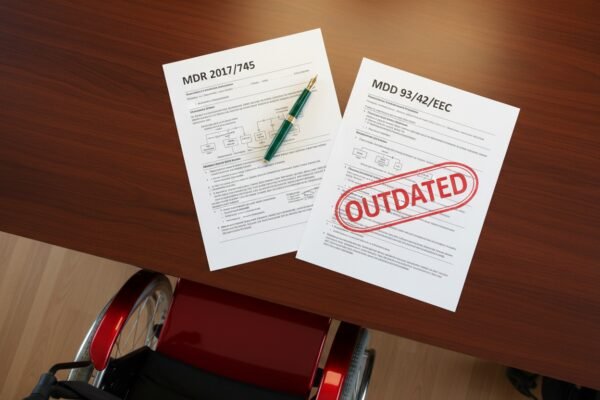
Since the transition from the Medical Device Directive (MDD 93/42/EEC) 5 to the Medical Device Regulation (MDR 2017/745), any certificate still referencing only MDD without MDR compliance is a major red flag. The MDR has been enforced since May 2021. Our team updated all documentation during that transition, and legitimate manufacturers should have done the same. If a supplier shows you a certificate that only references MDD, ask them to explain. In 2023 vetting studies, 47% of Chinese suppliers were flagged for issues including expired Notified Body codes or outdated directive references.
Which official databases should I use to cross-check my supplier's medical device documentation?
When we prepare export documentation for our wheelchair buyers, we always encourage them to verify everything independently. Trust is important, but verification protects both parties.
Use the EU NANDO database to verify Notified Bodies, IAF CertSearch to validate ISO 13485 certificates, the CNAS website to confirm Chinese testing lab accreditation, and the EUDAMED database to check Unique Device Identification and Single Registration Numbers for medical devices.

EU NANDO Database
This is your first stop. NANDO stands for New Approach Notified and Designated Organisations. It lists every Notified Body authorized by EU member states. You can search by NB number, by country, or by directive/regulation. For electric wheelchairs, search under MDR 2017/745 and the Machinery Directive 2006/42/EC. If the NB on your supplier's certificate is not listed, or its scope does not cover medical devices, walk away.
IAF CertSearch
The International Accreditation Forum maintains a global database called IAF CertSearch 6. This tool lets you verify ISO 13485 7 quality management system certificates. Type in the manufacturer's name or certificate number. The database shows the issuing Certification Body, the scope, and whether the certificate is active. This is critical because ISO 13485 is the quality management standard specifically for medical device manufacturers. Without it, a manufacturer cannot reliably produce CE-compliant wheelchairs.
CNAS Website
Many Chinese manufacturers use domestic testing laboratories for their product testing. The China National Accreditation Service for Conformity Assessment (CNAS) maintains a searchable directory. CNAS website 8 You can verify if a testing lab holds ISO 17025 accreditation and whether its scope covers the specific tests required for electric wheelchairs, such as EMC testing per EN 61000 series or safety testing per EN 12184. A lab without proper CNAS accreditation in the relevant scope should not be trusted.
EUDAMED Database
The European Database on Medical Devices is still rolling out in phases, but it already allows you to look up Unique Device Identifiers (UDI) and Single Registration Numbers (SRN) for manufacturers and devices. EUDAMED database 9 If your supplier claims their wheelchair is registered in EUDAMED, you can verify this directly. Keep in mind that EUDAMED is not yet fully complete, so the absence of a listing does not always mean non-compliance. But a confirmed listing is a strong positive signal.
| Database | What It Verifies | URL |
|---|---|---|
| EU NANDO | Notified Body authorization and scope | ec.europa.eu/growth/tools-databases/nando |
| IAF CertSearch | ISO 13485 certificate validity | iafcertsearch.org |
| CNAS | Chinese testing lab accreditation (ISO 17025) | cnas.org.cn |
| EUDAMED | UDI, SRN, device registration | ec.europa.eu/tools/eudamed |
| IEC Databases | IEC/EN test report validity | iecee.org |
Combine Multiple Checks
No single database tells the full story. We always recommend buyers use at least three of these databases in combination. For example, verify the NB on NANDO, check the ISO 13485 on IAF CertSearch, and confirm the testing lab on CNAS. This triangulation approach catches most fraudulent documentation. In our own export process, we proactively provide links and certificate numbers so buyers can verify everything themselves. A manufacturer who resists your verification attempts is a supplier you should avoid.
What specific technical files must I request from my manufacturer to ensure full CE compliance?
Our engineering team spends significant time building and maintaining technical files for every wheelchair model we produce. These files are not optional. They are the backbone of CE compliance and the first thing an EU authority will ask for during a market surveillance check.
Request the full Technical File including the Declaration of Conformity referencing MDR 2017/745, risk management documentation per ISO 14971, EN 12184 test reports, EMC test results per EN 61000 series, battery UN38.3 certification, clinical evaluation, and the manufacturer's ISO 13485 quality management certificate.
Declaration of Conformity (DoC)
The DoC is the manufacturer's formal statement that the product meets all applicable EU requirements. It must reference the specific regulation (MDR 2017/745 for medical devices), list the harmonized standards applied, include the Notified Body's identification number, and be signed by an authorized representative. A DoC that only mentions the old MDD 93/42/EEC without MDR reference is outdated and non-compliant.
Risk Management File
Under ISO 14971 10, the manufacturer must maintain a comprehensive risk management file. This includes hazard identification, risk estimation, risk evaluation, and risk control measures for the wheelchair. It should cover mechanical risks, electrical risks, battery risks, software risks, and use-error risks. Ask to see the risk management summary or at least confirm it exists and is referenced in the Technical File.
EN 12184 Test Reports
EN 12184 is the key harmonized standard for electrically powered wheelchairs. It covers stability, driving performance, durability, and safety. Ask for the full test report, not just a summary. The report should be issued by an accredited laboratory and reference the specific wheelchair model you are purchasing. Performance thresholds like emergency stop response time (must be under 0.25 seconds) should be documented.
EMC and Electrical Safety Reports
Electric wheelchairs contain motors, controllers, and batteries. They must comply with electromagnetic compatibility requirements per the EN 61000-6 series and electrical safety requirements under the Low Voltage Directive. Request the EMC test report showing both emissions (EN 61000-6-3 or 6-4) and immunity (EN 61000-6-1 or 6-2) results.
Battery Certification
Lithium batteries used in electric wheelchairs must pass UN38.3 testing for transportation safety. This is a non-negotiable requirement for both safety and shipping compliance. Ask for the UN38.3 test summary and the MSDS (Material Safety Data Sheet) for the battery pack.
| Document | Standard/Regulation | Why It Matters |
|---|---|---|
| Declaration of Conformity | MDR 2017/745 | Legal declaration of compliance; required for market entry |
| Risk Management File | ISO 14971 | Proves systematic hazard analysis and risk controls |
| EN 12184 Test Report | EN 12184 | Core safety and performance standard for powered wheelchairs |
| EMC Test Report | EN 61000-6 series | Proves electromagnetic compatibility of motors and electronics |
| Battery Test Report | UN38.3 | Required for lithium battery safety and transport |
| ISO 13485 Certificate | ISO 13485 | Proves quality management system for medical devices |
| Clinical Evaluation | MDR Annex XIV | Demonstrates clinical safety and performance evidence |
| Post-Market Surveillance Plan | MDR Article 83-86 | Shows ongoing monitoring commitment |
Clinical Evaluation and Post-Market Surveillance
Under MDR, the manufacturer must provide a clinical evaluation report. For Class IIa devices like electric wheelchairs, this can often rely on existing clinical data and literature rather than new clinical trials. But it must exist. Additionally, ask about the manufacturer's post-market surveillance (PMS) plan. MDR requires manufacturers to actively monitor their devices after they reach the market. A supplier who has never heard of PMS is not MDR compliant.
Software Documentation
If your electric wheelchair has programmable controls, a mobile app, or connected features, the manufacturer must also demonstrate compliance with IEC 62304 for medical device software lifecycle processes. This is increasingly important as more wheelchairs include smart features. Ask specifically about software validation and cybersecurity risk assessments.
Supply Chain Traceability
Request documentation showing the origin and certification of critical components. Where do the motors come from? Who makes the batteries? Are the controllers sourced from qualified suppliers? At our facility in Foshan, we maintain traceability records for every major component. This is not just good practice. It is required under MDR's supply chain transparency requirements and helps you avoid counterfeit parts entering your products.
How do I protect my business from the legal risks of importing wheelchairs with fake CE marks?
We have seen too many distributors learn this lesson the hard way. One case that circulated in the industry involved a Brazilian importer who lost €412,000 when authorities found their imported vehicles carried fraudulent CE marks. Electric wheelchairs carry the same risk, and the consequences can be even more severe because they are medical devices.
Protect your business by implementing a supplier vetting checklist before placing orders, including contractual warranty clauses for CE compliance, arranging independent pre-shipment inspections, purchasing product liability insurance, and documenting every verification step to demonstrate due diligence in case of regulatory inquiry.
Build a Supplier Vetting Checklist
Before you send a purchase order, complete a structured vetting process. This should include all the database checks mentioned earlier (NANDO, IAF CertSearch, CNAS), a request for the full Technical File, and a factory audit or at minimum a virtual factory tour. At our company, we welcome buyer audits because we know they build long-term trust. A supplier who refuses an audit or delays document sharing is a red flag.
Use Contractual Protections
Your purchase contract should include explicit warranty clauses stating that all products comply with MDR 2017/745, carry legitimate CE marking, and are supported by valid technical documentation. Include penalty clauses for non-compliance. Specify that the manufacturer is responsible for all costs related to product recalls, customs seizures, or regulatory fines caused by documentation failures. Have a legal professional in the destination country review the contract.
Arrange Independent Pre-Shipment Inspections
Hire a third-party inspection company like SGS, Bureau Veritas, or TÜV to conduct a pre-shipment inspection at the factory. The inspector should verify the CE mark on products, check that documentation matches the goods, and perform basic functional tests. This costs a fraction of what you would lose if a shipment is rejected at customs. We work with third-party inspectors regularly and consider it a normal part of professional international trade.
Maintain a Due Diligence File
Keep a complete record of every verification step you take. Save screenshots of NANDO searches, email confirmations from Notified Bodies, copies of test reports, and inspection records. If a regulator ever questions your products, this file demonstrates that you acted responsibly. Under MDR, EU importers have specific legal obligations. You cannot simply claim ignorance if your products turn out to be non-compliant.
Understand Your Legal Exposure
Under EU MDR, importers are considered economic operators with defined responsibilities. You must verify that the manufacturer has performed the conformity assessment. You must ensure the Technical File is available. You must verify that the device is registered and carries proper UDI labeling. If you fail to do these things and a patient is harmed, you can face civil liability, criminal prosecution, product recalls, and massive fines.
Product Liability Insurance
Invest in product liability insurance that specifically covers medical devices. Make sure the policy covers claims arising from regulatory non-compliance, product defects, and personal injury. This is your financial safety net. The cost of insurance is always less than the cost of an uninsured claim.
Red Flags That Should Stop a Deal
Here are warning signs that should make you pause or walk away entirely.
- The supplier cannot provide a Technical File within a reasonable timeframe.
- The CE certificate references only MDD, not MDR.
- The Notified Body number does not appear in NANDO.
- The supplier offers unusually low prices that undercut all competitors.
- The CE mark on the product is a sticker rather than embossed.
- The supplier pressures you to skip inspections or verification.
- Test reports are image files rather than original PDFs from accredited labs.
In 2023, 11% of certificates examined from Chinese suppliers showed ink inconsistencies upon forensic analysis. Two suppliers were found using expired Italian Notified Body codes. These are not theoretical risks. They happen regularly, and only a disciplined verification process protects you.
Conclusion
Verifying CE certifications is not optional when sourcing electric wheelchairs from China. Use official databases, request complete technical files, inspect products physically, and protect yourself with contracts and insurance. Your due diligence today prevents costly disasters tomorrow.
Footnotes
1. Official European Commission page explaining CE marking. ↩︎
2. Explains the identification number for Notified Bodies under EU regulations. ↩︎
3. Official text of the Medical Device Regulation (MDR) from EUR-Lex. ↩︎
4. Official European Commission database for Notified Bodies. ↩︎
5. Official consolidated text of the repealed Medical Device Directive. ↩︎
6. Official global database for accredited certifications. ↩︎
7. Official ISO page for the Quality Management Systems for Medical Devices standard. ↩︎
8. HTTP 404 ↩︎
9. Official European Commission database for medical devices. ↩︎
10. Official ISO page for the Medical devices – Application of risk management standard. ↩︎