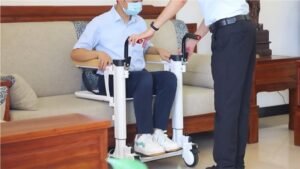

Purpose of wheelchair application
To accomplish the doing up and moving of patients who cannot walk, to help patients get out of bed, and to promote blood circulation and physical strength recovery.
Selection of wheelchair
Wheelchair seat width: 2.5cm gap on each side of the buttocks after sitting down, to prevent the buttocks and thighs from being compressed, which may lead to fatigue of the lower limbs and instability of the trunk.
Wheelchair seat length: Measure the horizontal distance from the buttocks to the popliteal fossa after sitting down, and subtract 6.5 cm from the measurement to prevent long term seating from causing compression of blood vessels and nerve tissues as well as skin abrasion.
Wheelchair backrest height: Normally, the upper edge of the backrest is 10 centimeters from the armpit, and the height of the backrest can be adjusted according to the patient’s individual activity requirements, the lower the backrest, the greater the range of motion, and the higher the requirements for body balance.
Wheelchair armrest height: arms hanging down naturally, forearms placed on the armrests, elbow flexion of about 90 ° is normal, to prevent shoulder fatigue and abrasions.
Wheelchair seat height: Measure the distance from the heel of the foot to the popliteal fossa when sitting down, and add 4 centimeters to the seat height. When preventing footrests, the surface of the board should be at least 5 centimeters from the ground to prevent the seat from being too high to access the table or the pressure on the sit bones from being too great to cause pressure sores.
Flat drive: eyes looking ahead, body balance, forward drive, double upper limbs back, slightly bent elbow, hands holding the back half of the wheel ring, push the upper body forward, double upper limbs forward and straighten the elbow joints, when the elbow joints are completely straightened, let go of the wheel ring, and so on and so forth. When driving backward, do the opposite.
Turning training: turn to the left, for example, turn a big circle when the left and right hands are hard to promote the wheel ring, the right hand to promote the strength is greater than the left hand, turn a small circle, the left hand to hold the wheel ring is not hard to use the right hand to promote the wheel ring, turn to the right when the action is reversed.
Uphill and downhill movements: lean forward with your torso, shift your center of gravity forward, and push forward with both hands holding the back of the handwheel. When going downhill, lean back on the back of the wheelchair and hold the handwheel lightly to control the downward speed.
Indications of wheelchair
- People with reduced walking function or loss of walking function, such as double lower limb fracture not healed, amputation, paraplegia, other neuromuscular system diseases caused by the paralysis of both lower limbs, severe lower limb joint inflammation or disease, and so on.
- Non-motor system itself disease, but walking is unfavorable to the state of the whole body, such as cardiac failure, as well as other diseases caused by systemic failure.
- Central nervous system diseases that make independent walking dangerous, such as dementia, spatial disorientation and other intellectual and cognitive dysfunction, severe Parkinson’s disease or cerebral palsy patients.
- Elderly people who have difficulty walking and are prone to accidents.
- Special patient indications:Thoracolumbar spine fracture patients, avoid wheelchair within 1 month after surgery, after 1 month in the lumbar support can be fixed in a wheelchair; neck of femur fracture, femur fracture of the thick rondylus hip replacement surgery, after surgery in the wheelchair cushion needs to increase the height, so that the hip flexion is greater than 90 °.
Precautions
- Inspection and maintenance:Before use, you should check whether the parts of the wheelchair are intact, such as the seat, armrests, brakes, etc., and carry out regular maintenance and repair.
- Safe operation:When pushing the wheelchair, both hands should exert force evenly to avoid bumps, especially on uneven road surface. Pay attention to safety when using the brakes and avoid stopping at slopes.
- Keep the ground dry and the road free from obstacles to avoid accidents.
- Operation in Specific Situations:For example, when the wheelchair is going up and down slopes or steps, pay attention to body posture and directional control to prevent backward roll or forward stroke. When moving inside or outside the elevator, you should turn your back to the forward direction to ensure safety.
- Safety:For patients who are unable to maintain balance on their own, they should be secured with seat belts to avoid slipping off the wheelchair. When using a wheelchair for long periods of time, patients should be helped to stand or change positions regularly to avoid pressure sores and other health problems.