
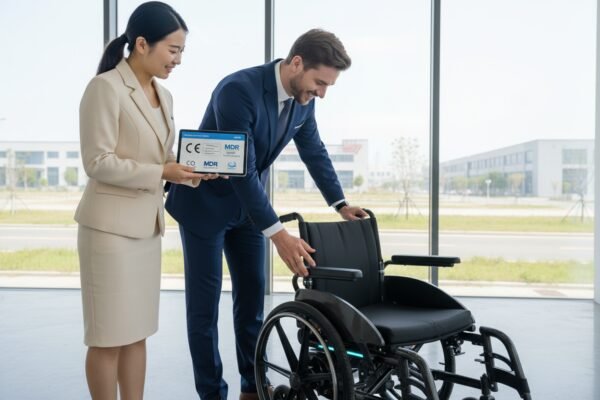
Every year, our export team fields dozens of inquiries from European distributors who lost months—and sometimes entire container shipments—because a wheelchair looked great on paper but failed on documentation, stability testing, or battery compliance at the border EN 12184 safety performance 1. CE MDR compliance documentation 2
The technical parameters that matter most when sourcing electric wheelchairs for Europe include CE MDR compliance documentation, EN 12184 safety performance (stability, braking, EMC), battery system certification, frame durability under load, and customization flexibility—because these directly determine legal market entry, user safety, and long-term distributor profitability.
This guide walks through each critical parameter from a procurement perspective UDI Registration records 3. We will cover regulatory pass/fail items, real-world performance benchmarks, and the documentation that separates smooth customs clearance from costly delays. Let’s start with the legal foundation.
How do I verify that the electric wheelchairs meet the latest CE MDR requirements for my European customers?
When we prepare shipments for our UK and EU partners, the compliance paperwork often takes more effort than the physical production IEC 62133 standards 4. A missing test report or an outdated declaration can halt an entire order at customs, and the cost falls on the distributor.
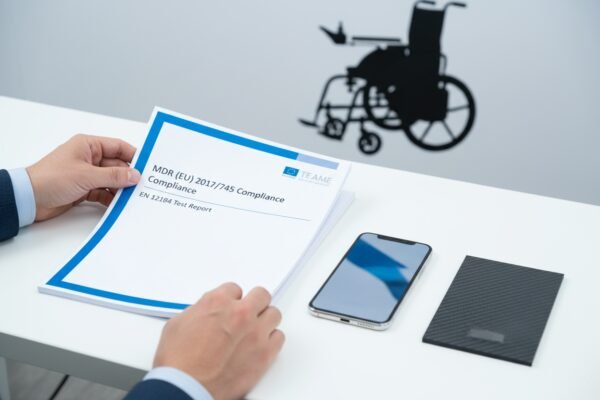
To verify CE MDR compliance, request the full technical file including the EU Declaration of Conformity, EN 12184 test reports, risk management documentation per ISO 14971, clinical evaluation, UDI registration records, and proper labeling—all aligned with MDR (EU) 2017/745 rather than the old MDD 93/42/EEC directive.
Understanding the Regulatory Shift from MDD to MDR
The Medical Device Regulation (EU) 2017/745 replaced the older Medical Device Directive 93/42/EEC. This is not a minor update. MDR tightened requirements around post-market surveillance, clinical evaluation, and traceability. Electric wheelchairs are classified as medical devices. If your supplier still references MDD certificates, that is an immediate red flag. MDR demands a more complete technical file and stricter oversight throughout the product lifecycle.
The Core Standard: EN 12184
EN 12184 is the European standard for electrically powered wheelchairs, including scooters. It covers mechanical safety, electrical safety, electromagnetic compatibility, stability, braking, and battery performance. It draws heavily on the ISO 7176 family of test methods 5. When you evaluate a supplier, ask specifically for EN 12184 test reports from accredited laboratories. A general "CE certificate" without supporting test data is not sufficient.
What Documents Should You Request?
| Document | Purpose | Why It Matters for Distributors |
|---|---|---|
| EU Declaration of Conformity | Legal statement that the product meets MDR | Required for customs clearance and market surveillance |
| EN 12184 Test Reports | Proof of safety and performance testing | Validates stability, braking, EMC, and electrical safety |
| Risk Management File (ISO 14971 6) | Systematic hazard analysis | Shows due diligence; reduces liability exposure |
| Clinical Evaluation Report | Evidence of clinical benefit and safety | Mandatory under MDR; often missing in budget suppliers |
| UDI Registration | Unique Device Identification | Required for EUDAMED database entry and traceability |
| Instructions for Use (IFU) | User-facing documentation in required languages | Non-compliant IFUs trigger market surveillance actions |
Common Documentation Pitfalls
In our experience shipping to distributors across Germany, the Netherlands, and the UK, the most frequent compliance failures are not failed lab tests. They are incomplete files. A supplier may have valid test reports but lack a current clinical evaluation. Or the Declaration of Conformity references the old directive instead of MDR. Another common issue is missing language translations for the Instructions for Use. Each EU member state can require the IFU in its official language. The UK market has its own UKCA marking requirements post-Brexit, which adds another layer.
Distributors should treat documentation as a technical parameter itself. The best-performing wheelchair is unsellable if the file is incomplete. Before placing a large order, request sample documentation and have it reviewed by a regulatory consultant. This step costs far less than a detained shipment.
Which motor and battery specifications will provide the reliability my high-end distribution network demands?
Our engineering team spends significant time matching motor and battery configurations to specific market demands. A folding chair for urban UK buyers needs a very different power system than a heavy-duty model for a Scandinavian rehab center.
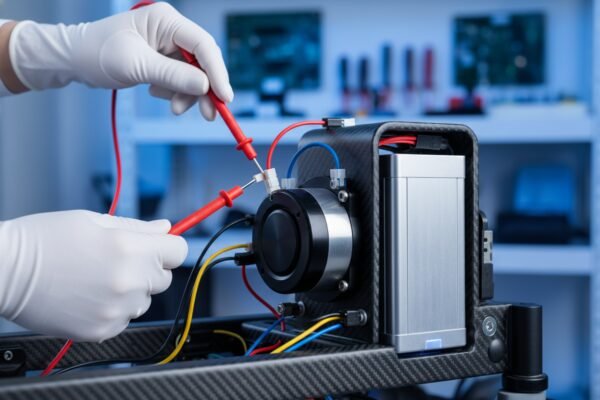
Reliable motor and battery specs for high-end European distribution include brushless DC motors rated 200–500 W per wheel, lithium-ion batteries with certified BMS (battery management systems) offering 30–50 km real-world range, thermal protection, and compliance with UN 38.3 transport safety testing and IEC 62133 standards.
Motor Types and What They Mean for Distributors
Most quality electric wheelchairs use brushless DC motors. They are quieter, more efficient, and last longer than brushed alternatives. For mid-to-high-end European distribution, dual-motor configurations are standard because they enable differential steering and better slope performance. Motor wattage typically ranges from 200 W to 500 W per side, depending on intended use.
Higher wattage does not always mean better. What matters is sustained torque output, efficiency under load, and thermal management. A 250 W motor that maintains consistent output on a 12° slope is more valuable than a 400 W motor that overheats after five minutes of climbing.
Battery Chemistry: Lithium-Ion vs. Sealed Lead-Acid
| Parameter | Lithium-Ion (Li-ion) | Sealed Lead-Acid (SLA) |
|---|---|---|
| Weight (typical 24V pack) | 3–6 kg | 10–15 kg |
| Cycle Life | 500–1000+ cycles | 200–400 cycles |
| Range (typical) | 30–50 km | 15–25 km |
| Charging Time | 4–6 hours | 8–12 hours |
| Airline Compliance | Possible (≤ 270 Wh) | Generally not permitted |
| Upfront Cost | Higher | Lower |
| Replacement Complexity | Moderate (BMS dependent) | Simple swap |
| Transport Certification | UN 38.3 required | Standard freight |
Lithium-ion dominates the premium and folding segments. The weight savings alone can be 7–10 kg, which matters enormously for folding models designed for car trunks or public transport. However, lithium batteries raise transport compliance issues. UN 38.3 testing is mandatory for air and sea freight. Without it, your shipment can be refused or delayed.
Some institutional buyers still prefer SLA for lower upfront cost and simpler servicing. We advise distributors to maintain both options in their portfolio.
Battery Management System: The Hidden Quality Marker
A good BMS protects against overcharge, over-discharge, short circuit, and thermal runaway. It also balances individual cells to extend overall pack life. When evaluating suppliers, ask for BMS specifications and certifications. A cheap battery pack without proper BMS is a warranty claim waiting to happen. We build our packs with multi-layer protection including low-voltage cutoff, temperature monitoring, and automatic charging shutoff.
Interrogating Range Claims
Published range figures are often optimistic. They may assume a 75 kg rider on flat, smooth ground at moderate speed with a new battery. Real-world range drops significantly with heavier riders, hills, cold weather, and aged batteries. Ask your supplier for the test conditions behind any range claim. ISO 7176-4 provides a standardized method for energy consumption measurement. Distributors who compare range figures without matching test conditions will make poor sourcing decisions.
Charger Documentation
Do not overlook the charger. It must comply with relevant European safety standards. The charger should match the battery chemistry precisely. Mismatched chargers cause overheating, reduced battery life, and safety risks. We supply matched charger-battery pairs and include charger compliance documentation in every technical file.
How can I evaluate the frame material and weight capacity to ensure long-term durability for my fleet?
On our production line, we test frame samples to failure before approving a new design. We have seen competitors use thinner tubing or lower-grade aluminum to cut costs, and the result is warranty claims within the first year. Durability is not visible in a product photo—it shows up in fatigue data and real-world returns.
Evaluate frame durability by reviewing the material grade (6061-T6 aluminum or carbon fiber composites), weld quality certifications, ISO 7176 fatigue and vibration test results, rated load capacity versus safety margins, and the supplier's bariatric and heavy-duty options—because frame failure is the costliest warranty issue for fleet distributors.
Frame Materials Compared
| Material | Strength-to-Weight | Corrosion Resistance | Cost | Common Use |
|---|---|---|---|---|
| 6061-T6 Aluminum 9 | High | Good (anodized) | Moderate | Standard and folding models |
| 7075 Aluminum | Very High | Moderate | Higher | Performance / lightweight |
| Carbon Fiber Composite | Excellent | Excellent | Premium | Ultra-light, high-end models |
| Steel (CrMo) | Very High | Requires coating | Low-Moderate | Heavy-duty / bariatric |
| Magnesium Alloy | High | Requires treatment | High | Ultra-light travel chairs |
For most mid-to-high-end European distribution, 6061-T6 aluminum is the workhorse. It offers a strong balance of weight, durability, and cost. Carbon fiber appears in premium models and provides a visible quality cue—the weave texture signals high-end engineering to retail buyers. Steel remains relevant for bariatric models where maximum strength under loads exceeding 200 kg is the priority.
Load Capacity: Standard, Heavy-Duty, and Bariatric
European distributors typically need a tiered product portfolio. Standard models carry up to 120–130 kg. Heavy-duty models handle 150–180 kg. Bariatric models serve users up to 250 kg or more. Each tier requires different frame tube diameters, weld reinforcements, wheel axle ratings, and caster specs.
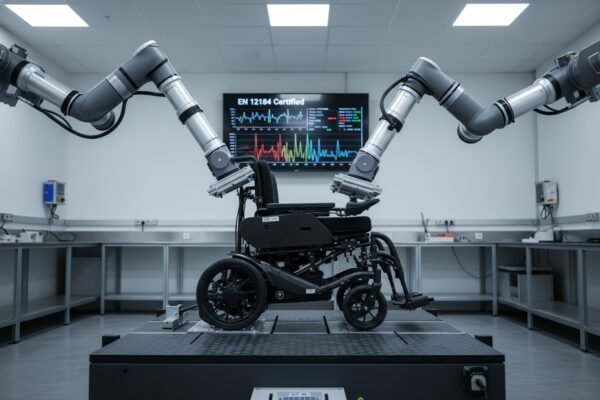
The rated load capacity should include a safety margin. If a chair is rated for 130 kg, it should have been tested at higher loads during fatigue cycling. Ask for ISO 7176-8 static, impact, and fatigue test results 10. These tests simulate thousands of use cycles and reveal weaknesses that a simple static load test will miss.
Fatigue, Vibration, and Environmental Testing
The ISO 7176 family includes methods for drum and multi-drum fatigue testing, vibration resistance, and climatic exposure. For fleet use in rehabilitation centers and rental programs, these tests are critical. A chair that passes initial inspection but develops frame cracks after six months of daily institutional use is a disaster for distributor margins and reputation.
We run extended fatigue cycles beyond the minimum standard requirement on our production samples. This gives our distribution partners confidence that the chairs will survive intensive daily use in care facilities and rental fleets.
Weld Quality and Finishing
Frame failure almost always starts at a weld. Look for suppliers who can show weld quality certifications or inspection records. Surface finishing—powder coating, anodizing, or painting—affects both appearance and corrosion resistance. In European markets, a visible scratch or peeling finish after a few months signals low quality and triggers complaints. We use multi-layer powder coating with salt spray testing to verify corrosion resistance for at least 500 hours.
Portability vs. Durability Tradeoff
The folding power wheelchair market is growing fast in Europe. Buyers want chairs that fold small, fit in a car trunk, and weigh under 25 kg. But lighter frames and folding hinges introduce stress points. Distributors must balance portability demands against structural integrity. A folding hinge that loosens over time or a lightweight frame that flexes under a heavier rider will generate returns and damage your brand.
Our approach is to reinforce folding joints with CNC-machined locking mechanisms and use finite element analysis to optimize tube thickness at stress points. This way, we keep the chair compact and light without sacrificing durability.
What technical customization options can I request to differentiate my brand in the competitive UK and EU markets?
When we work with European distribution partners, the conversations that create real competitive advantage go far beyond color choices. Our OEM/ODM process starts with understanding the distributor's target channel—rehab, retail, or e-commerce travel—and then configuring technical features that match specific end-user needs.
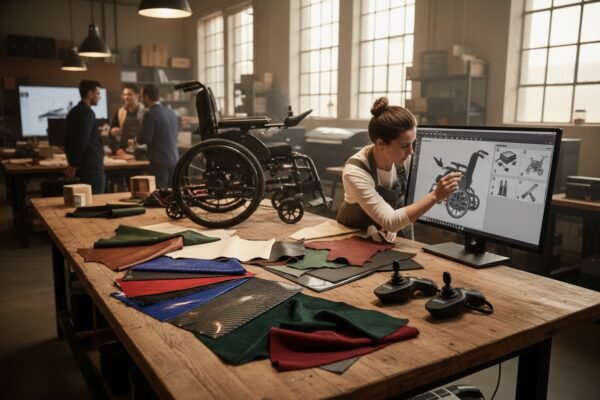
Key customization options include branded joystick controller programming, modular seating systems with pressure-relief cushions, configurable speed and braking profiles, color and upholstery branding, alternative battery capacities, smart connectivity modules, and channel-specific packaging—all of which help distributors build a distinct product identity in crowded European markets.
Controller and Drive Profile Customization
The joystick controller is the user's primary interface. Higher-end controllers from suppliers like PG Drives or Dynamic Controls allow programmable speed profiles, acceleration curves, and sensitivity settings. We can configure these profiles to match your market segment. A chair for elderly home-care users may need gentler acceleration and tighter speed limits, while a model aimed at active younger users can have sportier response.
Some distributors also request alternative input devices: head arrays, chin controls, or sip-and-puff systems for users with limited hand function. These add complexity but dramatically expand the addressable market in the rehab segment.
Seating System and Pressure Management
For rehab distributors, seating is where clinical value lives. We offer modular seating platforms that accept different cushion types—memory foam, gel, air-cell, or hybrid. Backrest adjustability, lateral supports, headrests, and seat tilt are all configurable.
Pressure ulcer prevention is a major concern for long-duration users. Breathable, moisture-wicking fabrics and contoured cushion profiles reduce skin breakdown risk. Electrically adjustable seat tilt, recline, and leg elevation are available on higher-end models. We always include a manual override mechanism in case of power failure—a requirement that some buyers overlook until a user is stranded in a reclined position.
Branding and Aesthetic Differentiation
Color, upholstery, logo placement, and packaging are basic but powerful differentiators. We support custom RAL color matching for frames, branded shroud panels, and embroidered or printed logos on seat covers. Packaging can be configured with your brand identity, QR codes linking to your support portal, and multilingual quick-start guides.
Smart Features and Connectivity
The European market is moving toward connected medical devices. We can integrate Bluetooth modules for app-based diagnostics, usage tracking, and firmware updates. This enables distributors to offer remote troubleshooting, which reduces service costs and improves user satisfaction.
However, smart features raise EMC and cybersecurity considerations. EN 12184 references ISO 7176-21 for electromagnetic compatibility. Any wireless module must be tested in the final product configuration, with accessories attached, not in isolation. Data privacy under GDPR also applies if the app collects user data. We advise distributors to define connectivity requirements early so that testing and documentation align from the start.
Sustainability and End-of-Life Considerations
European procurement increasingly values sustainability. We can specify recyclable frame materials, replaceable battery packs with clear recycling pathways, and packaging made from recycled cardboard. Modular design helps here too—when individual components can be swapped rather than discarding the entire chair, the product lifespan extends and waste decreases.
Channel-Specific Configuration Strategy
| Distribution Channel | Priority Customizations | Key Technical Focus |
|---|---|---|
| Rehab Centers | Adjustable seating, pressure relief, alternative controls | Clinical outcomes, durability, serviceability |
| Retail / Mobility Shops | Attractive finish, compact folding, travel battery | Aesthetics, portability, ease of demo |
| E-commerce / Travel Segment | Ultra-light frame, airline-safe battery, compact box | Weight, folding speed, unboxing experience |
| Home Care Agencies | Easy cleaning, simple controls, fleet tracking | Infection control, low maintenance, remote diagnostics |
Customization is not about offering everything. It is about matching specific features to your distribution channel. A scatter-shot approach wastes development time and inflates SKU count. We work with each partner to define a focused product matrix—usually three to five configurations—that covers their core segments without creating inventory nightmares.
Telehealth and Remote Diagnostics
One emerging customization request we receive is telehealth readiness. Embedded sensors can monitor battery health, motor temperature, and usage patterns. This data can be transmitted to a cloud dashboard, allowing distributor service teams to proactively schedule maintenance or identify failing components before the user experiences a breakdown. For fleet operators and rental programs, this capability reduces downtime and extends asset life.
Fire Safety and Material Compliance
For institutional markets, especially care homes, fire safety is not optional. We use low-flammability foams and fabrics that comply with relevant European fire safety standards. Seat covers are designed for easy removal and cleaning, meeting infection control protocols. Battery enclosures use flame-retardant plastics. These details do not appear on a product brochure, but they determine whether a wheelchair gets accepted into a hospital or care home procurement list.
Conclusion
Sourcing electric wheelchairs for Europe demands more than comparing price lists. It requires verifying regulatory documentation, testing real-world performance claims, evaluating structural durability, and aligning customization with your specific distribution channel for long-term success.
Footnotes
1. Authoritative source for the EN 12184 standard, detailing requirements and test methods for electric wheelchairs. ↩︎
2. Explains the importance of regulatory compliance for market entry. ↩︎
3. Explains the requirement for unique device identification under MDR. ↩︎
4. Identifies an international standard for safety of secondary cells and batteries. ↩︎
5. Introduces the comprehensive set of international standards for wheelchair testing. ↩︎
6. Details the international standard for risk management in medical devices. ↩︎
7. Official consolidated text of the Medical Device Regulation (EU) 2017/745 on EUR-Lex. ↩︎
8. Specifies a critical safety test for lithium batteries during transport. ↩︎
9. Describes a common and durable material used in wheelchair frames. ↩︎
10. Authoritative source for BS ISO 7176-8 standard, specifying requirements and test methods for static, impact, and fatigue strengths of wheelchairs. ↩︎