
Every year, our production team reviews incident reports from hospital clients who purchased commode chairs based on price alone—the pattern of preventable injuries is alarming.
When buying mobile commode chairs for private hospitals, prioritize reliable four-wheel braking systems, corrosion-resistant frames with verified weight capacities, anti-slip footrest designs, lockable swing-away armrests, pressure-reducing seat apertures, and hygiene-compatible materials that withstand hospital-grade disinfectants.
Below, I break down the specific design details that protect patients, reduce liability, and support your caregiving staff across four critical areas.
How can I verify that the braking system on mobile commode chairs is reliable enough for my high-traffic hospital wards?
When we test braking mechanisms on our production line, we simulate wet bathroom floors and sloped surfaces—because that is where most commode-related falls happen in real hospital use four-wheel braking systems 1.
Verify brake reliability by confirming lever-activated locks on all four wheels, testing engagement force consistency, checking for automatic lock features, and requesting wet-surface performance data from the manufacturer before purchasing.
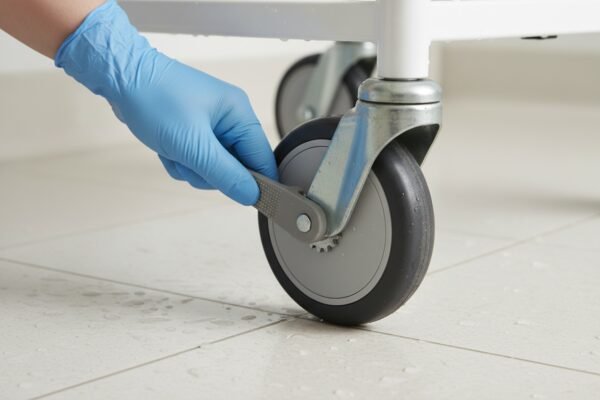
Why Brakes Fail in Hospital Settings
Most brake failures happen not because the mechanism is broken but because staff forget to engage them or the lock wears down over time 304 or 316 stainless steel 2. In our experience shipping to European distributors, we have learned that intuitive brake design matters more than brake strength alone. If a nurse must bend down or use excessive force, engagement rates drop significantly during busy shifts static load testing 3.
Wet environments compound the problem. Soap residue, water splashes, and cleaning chemicals reduce friction between rubber tips and tile floors. A brake that works perfectly on dry surfaces may slide on wet porcelain anti-slip footrest designs 4.
What to Test Before Purchasing
| Test Criteria | What to Check | Acceptable Standard |
|---|---|---|
| Engagement force | Push lever with one hand | Less than 5 Newtons required |
| Wet surface hold | Lock brakes on wet tile, push chair | Zero movement under 20 kg lateral force |
| Wear simulation | Engage/disengage 500 cycles | No degradation in lock firmness |
| Visual indicator | Brake position visible to staff | Color-coded or raised indicator |
Brake Types Compared
There are two common configurations: foot-pedal brakes and hand-lever brakes hospital-grade disinfectants 5. Foot-pedal brakes require staff to bend down. Hand-lever brakes are accessible from standing position. For high-traffic wards, hand-lever brakes reduce time per engagement and increase compliance.
Self-propelled models with larger rear wheels should include drum brakes or friction brakes on the rear wheels in addition to caster locks. This dual system prevents rolling on ramps or uneven thresholds.
Ask your supplier for brake test certificates. At our facility, we conduct 1,000-cycle fatigue tests and wet-floor simulations before shipment. If a supplier cannot provide this data, move on.
What frame materials should I prioritize to ensure my mobile commode chairs support bariatric patients safely?
Our engineering team has reinforced frames for bariatric applications multiple times after hospital clients reported bending on standard aluminum tubing—material choice is not optional, it is structural safety.
Prioritize 304 or 316 stainless steel or aircraft-grade aluminum alloy frames with welded (not bolted) joints, verified static load testing to at least 150% of rated capacity, and corrosion-resistant coatings for wet environments to safely support bariatric patients.
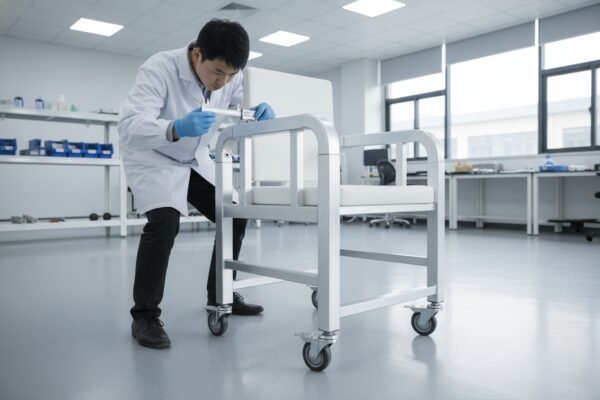
Material Comparison for Hospital Commode Frames
| Material | Weight Capacity Potential | Corrosion Resistance | Weight | Cost Level |
|---|---|---|---|---|
| Mild steel (powder coated) | Up to 200 kg | Moderate (coating chips) | Heavy | Low |
| 304 stainless steel | Up to 350 kg | Excellent | Heavy | Mid-high |
| 316 stainless steel | Up to 450 kg | Superior (salt/chemical) | Heavy | High |
| 6061 aluminum alloy | Up to 250 kg | Good (anodized) | Light | Mid |
| Chromoly steel | Up to 500 kg+ | Good (with treatment) | Medium | High |
Why Welded Joints Matter
Bolted connections loosen over time. Every vibration, every transfer, every bump over a threshold works bolts loose. In bariatric applications where loads exceed 150 kg, a single loose bolt can cause catastrophic frame failure. We weld all critical joints on our bariatric models and then X-ray inspect the welds for internal cracks.
Weight Capacity Verification
Never trust a nameplate alone. Request the test report showing static and dynamic load testing. Static testing applies weight gradually. Dynamic testing simulates a patient dropping into the seat. The industry standard is testing to 150% of rated capacity. For a chair rated at 250 kg, the frame should survive 375 kg static load without permanent deformation.
Private hospitals serving diverse populations should stock at least two tiers: standard frames rated to 150 kg and bariatric frames rated to 300 kg or above. This prevents the dangerous practice of using undersized chairs for larger patients.
Corrosion Kills Frames Slowly
Hospital bathrooms expose frames to water, urine, feces, and harsh disinfectants daily. Powder-coated mild steel will chip at contact points within months, then rust internally. Stainless steel or properly anodized aluminum resists this degradation. The upfront cost difference pays for itself in equipment lifespan—typically 3-5 additional years of safe service.
How do specific anti-slip footrest designs help me reduce the risk of patient falls during transfers?
We redesigned our footrest system three times after hospital feedback showed that smooth, flat footrests caused heel slippage during wet transfers—small design details prevented real injuries.
Anti-slip footrest designs reduce fall risk by providing textured surfaces that grip wet feet, rounded heel cups that prevent heel ulcers, adjustable height settings matching patient leg length, and fold-away mechanisms that clear the transfer path completely.

The Transfer Moment Is the Danger Zone
Most commode-related falls happen during transfers—getting on or off the chair. Footrests create two distinct hazards. First, if they do not fold away completely, patients trip over them. Second, if they lack grip, wet feet slide forward during sitting or standing, pulling the patient off balance.
Key Footrest Design Features
| Feature | Safety Function | Common Failure Mode |
|---|---|---|
| Textured surface | Grip for wet/soapy feet | Smooth plastic becomes slippery |
| Rounded heel cups | Prevent heel pressure ulcers 7 | Flat edges dig into heels |
| Height adjustment | Proper knee angle (90°) | Fixed height causes dangling or cramping |
| Fold-away hinge | Clears transfer path | Rigid footrests block approach |
| Toe strap option | Prevents feet sliding off | Missing straps for confused patients |
Height Adjustment Is Non-Negotiable
When footrests are too low, patients' feet dangle. This causes blood pooling and increases the urge to reach for the floor. When footrests are too high, knees rise above hip level, increasing sacral pressure and sliding risk. The correct position places the thigh parallel to the seat with feet flat on the footrest.
Our adjustable footrests use pin-lock mechanisms at 2 cm intervals. This allows staff to set the correct height in seconds without tools. Non-adjustable footrests force a compromise that fits nobody well.
Heel Cup Design for Pressure Prevention
Patients who sit on commode chairs for extended bowel care—sometimes 30 minutes or more—develop heel pressure injuries from hard, flat footrest edges. Edgeless, rounded heel cups distribute pressure across a larger surface area. We mold ours from medical-grade EVA foam with drainage channels for water.
Clearing the Transfer Path
Swing-away or flip-up footrests must lock in the stowed position. A footrest that drops during transfer creates an immediate tripping hazard. Test the lock mechanism by shaking the chair—if the footrest drops, reject the design.
What hygiene-focused design details should I look for to maintain safety and infection control in my private facility?
When we select materials for our commode chair seats and frames, we run compatibility tests with over 15 common hospital disinfectants—because a chair that degrades under cleaning chemicals becomes both an infection risk and a structural hazard.
Look for seamless or underside-seamed upholstery, removable splash guards and buckets, smooth weld finishes without crevices, materials compatible with hospital-grade disinfectants, and drainage designs that prevent standing water where bacteria colonize.
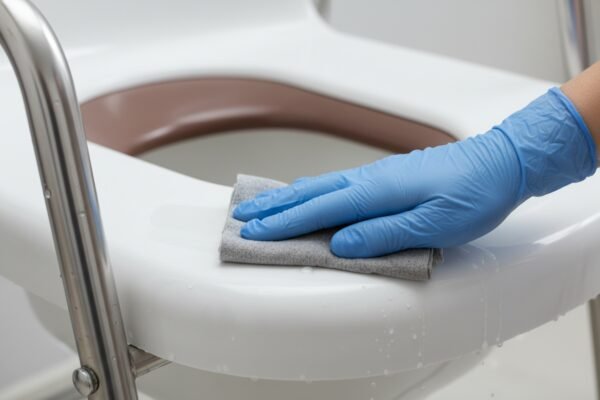
Why Design Affects Infection More Than Cleaning Protocols
You can have the best cleaning staff in the world, but if the chair has hidden crevices, rough weld beads, exposed foam, or standing water traps, bacteria will survive between patients. Design determines whether cleaning is possible, not just whether cleaning happens.
Critical Hygiene Design Points
Seams on seat cushions must face downward—never on the sitting surface. Upward-facing seams collect body fluids, resist wiping, and harbor pathogens. Vinyl covers should be heat-welded rather than stitched, eliminating needle holes that absorb moisture.
Removable buckets and pans need smooth internal surfaces without ridges. Ridged or textured buckets retain fecal matter in grooves. Our pans use polished internal surfaces that release waste with minimal water.
Frame welds should be ground smooth. Rough weld beads create micro-crevices where biofilm develops. Staff cannot effectively wipe surfaces they cannot reach or see.
Chemical Compatibility
Not all plastics and coatings survive hospital disinfectants. Chlorine-based cleaners degrade certain rubbers. Alcohol solutions crack some plastics over time. Hydrogen peroxide solutions bleach colored components.
Request a chemical compatibility chart from your supplier. It should list common agents like:
- Sodium hypochlorite (bleach)
- Quaternary ammonium compounds
- Hydrogen peroxide solutions
- Alcohol-based wipes
- Peracetic acid
If the supplier cannot provide this documentation, the product has not been designed for hospital use.
Drainage and Drying
Standing water breeds bacteria within hours. Shower commode chairs must drain completely when not in use. Seat surfaces should slope toward drain holes. Frame tubing should be sealed—open tube ends collect water internally and become impossible to clean.
Our chairs use capped tube ends and sloped seat surfaces with 3-degree drainage angles. After showering, water clears within 60 seconds without manual drying.
Conclusion
Selecting mobile commode chairs for private hospitals is a clinical safety decision—not a commodity purchase. Prioritize braking reliability, frame integrity, anti-slip footrests, and hygiene-compatible design to protect patients and staff.
Footnotes
1. Explains central locking casters, which simultaneously engage all four wheels for safety. ↩︎
2. Comprehensive guide to 304 and 316 stainless steel properties and medical applications. ↩︎
3. Explains static and dynamic testing methods for evaluating medical device safety and durability. ↩︎
4. Describes features of non-slip footplate pads, including textured surfaces and friction coefficients. ↩︎
5. CDC guidelines define and explain EPA-registered hospital disinfectants for infection control. ↩︎
6. WHO guidelines for assistive products, including mobile commode chairs. ↩︎
7. Provides NPIAP guidelines for preventing heel pressure injuries, a critical patient safety concern. ↩︎