

Every year, our sales team handles hundreds of purchase orders for aluminum shower chairs, and the disputes that cause the most damage are almost always rooted in vague or missing contract language.
The key contract terms that protect your rights when purchasing aluminum shower chairs include clearly defined quality inspection standards, enforceable warranty and after-sales clauses, structured delivery and lead time commitments with penalty provisions, and well-drafted payment terms paired with a transparent dispute resolution process.
The following sections break down each critical contract area so you can build stronger agreements and avoid costly surprises. Let's walk through them one by one.
How Can I Define Quality Inspection Standards in My Contract to Avoid Receiving Substandard Aluminum Shower Chairs?
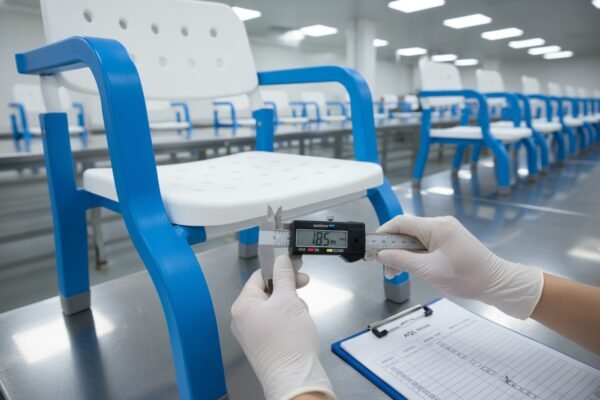
When we prepare shipments at our Foshan facility, the inspection stage is where most quality problems are either caught or missed — and the contract is what determines who has the authority to reject a batch.
To avoid receiving substandard aluminum shower chairs, your contract should specify the inspection method (such as AQL sampling), define acceptable defect rates, list measurable quality benchmarks for materials and dimensions, and state the buyer's right to reject non-conforming goods before shipment.
Why Vague Quality Language Creates Risk
Many buyers write contracts that say something like ""products must meet industry standards 2"" or ""quality should be acceptable."" These phrases sound reasonable, but they are almost impossible to enforce. If a shipment arrives with wobbly legs or rough weld seams, the supplier can argue that the product still meets ""industry standards."" The buyer has no clear benchmark to point to.
A better approach is to list specific, measurable criteria. For aluminum shower chairs, this means stating the exact alloy grade 3, the minimum wall thickness of the tubing, the weight capacity the chair must support, and the surface finish requirements. It also means specifying seat dimensions, armrest height ranges, and the type of non-slip feet included.
AQL Sampling and Third-Party Inspection
AQL (Acceptable Quality Level) sampling 4 is the most common method for batch inspection in international trade. It lets the buyer define how many units in a shipment will be randomly checked and what defect rate triggers rejection.
Here is a practical reference table:
| Inspection Level | Sample Size (per 1,000 units) | Critical Defect AQL | Major Defect AQL | Minor Defect AQL |
|---|---|---|---|---|
| Level I (Reduced) | 32 | 0 | 1.0% | 2.5% |
| Level II (Normal) | 80 | 0 | 1.5% | 4.0% |
| Level III (Tightened) | 125 | 0 | 0.65% | 1.5% |
Critical defects include structural failures, sharp edges, or missing safety features. Major defects cover things like incorrect seat height range or non-functional adjustment mechanisms. Minor defects might be small cosmetic scratches or slight color variations.
What to Include in the Inspection Clause
Your contract should answer these questions clearly:
- Who performs the inspection — the buyer, the supplier, or a third-party agency?
- When does inspection happen — before shipment, upon arrival, or both?
- What happens if the goods fail inspection — full replacement, partial refund, or rework?
- Who pays for re-inspection if the first batch fails?
Our experience exporting to Europe and North America has shown that buyers who use third-party inspection agencies 5 like SGS or Bureau Veritas have far fewer post-delivery disputes. The cost of inspection is small compared to the cost of receiving 500 defective shower chairs.
Material and Performance Benchmarks
Beyond visual inspection, the contract should require material certificates and performance test results. For aluminum shower chairs, this typically includes:
- Aluminum alloy certification (e.g., 6061-T6 or 6063)
- Static load test results showing the chair supports the rated weight capacity
- Salt spray test results 6 confirming corrosion resistance
- Non-slip feet grip test on wet surfaces
These documents give the buyer hard evidence if a dispute arises later. Without them, arguments about quality become subjective.
What Specific Warranty and After-Sales Terms Should I Demand to Protect My Long-Term Investment?
When we design our warranty policies at Bigcare, we know that the real test of a shower chair happens months after delivery — when joints loosen, coatings wear, or adjustment mechanisms stiffen from daily wet use.
To protect your long-term investment, demand a warranty that covers at least 12–24 months, explicitly includes frame structural integrity, corrosion resistance, and mechanical parts, defines the claims process with clear timelines, and specifies whether replacement parts or full units will be provided at the supplier's cost.

The Difference Between a Marketing Warranty and a Contract Warranty
Many suppliers advertise ""lifetime warranty on the frame"" or ""2-year full warranty"" on their product pages. But marketing language is not the same as contract language. A contract warranty 7 must state:
- Exactly what is covered (frame, seat, hardware, rubber feet, adjustment pins)
- What is excluded (normal wear, misuse, unauthorized modifications)
- The duration for each component
- The process for filing a claim
- The supplier's response time obligation
- Who pays for shipping defective parts back
Without these details, a warranty is just a promise with no teeth.
Warranty Duration by Component
Not every part of a shower chair wears at the same rate. A well-structured warranty reflects this reality:
| Component | Recommended Warranty Period | Common Failure Mode |
|---|---|---|
| Aluminum frame | 3–5 years | Weld cracking, bending under load |
| Seat and backrest | 1–2 years | Cracking, warping, surface degradation |
| Adjustment mechanism | 1–2 years | Pin corrosion, spring failure, sticking |
| Non-slip feet | 6–12 months | Rubber hardening, loss of grip |
| Hardware (screws, bolts) | 1–2 years | Corrosion, stripping, loosening |
This table helps buyers negotiate component-specific coverage rather than accepting a single blanket term that may leave critical parts unprotected.
After-Sales Support Clauses
Warranty is only useful if the buyer can actually get support when something goes wrong. The contract should include:
- A dedicated contact person or support channel for warranty claims
- A maximum response time (e.g., 48 hours for initial acknowledgment)
- Spare parts availability guarantee for at least 3 years after purchase
- Clear language on whether the supplier ships replacement parts internationally or only domestically
In our work with distributors across Europe and North America, we have found that the most common complaint is not product failure itself — it is the inability to get a timely response when failure happens. A contract that sets response deadlines solves this problem before it starts.
Corrosion-Specific Warranty Language
Aluminum is marketed as rust-resistant, and it is. But ""rust-resistant"" does not mean ""corrosion-proof."" Aluminum can still corrode when exposed to certain cleaning chemicals, saltwater environments, or prolonged contact with dissimilar metals. The warranty should state whether corrosion from normal bathroom use is covered, and whether the supplier guarantees the protective coating or anodizing for a specific period.
Buyers who skip this detail often discover that their warranty excludes the exact type of damage most likely to occur in a wet bathroom environment.
How Do I Structure the Delivery and Lead Time Clauses to Hold My Supplier Accountable for Delays?
Our production planning team in Foshan coordinates raw material sourcing, assembly, quality checks, and container loading on tight schedules — and we know firsthand that delays at any stage can cascade into missed delivery windows for our buyers.
To hold your supplier accountable for delays, structure your delivery clause with a firm ship-by date, define what constitutes a delay, include graduated penalty provisions for late delivery, specify acceptable force majeure exceptions, and require proactive written notice if the supplier anticipates any schedule slippage.

Why Delivery Delays Are More Than an Inconvenience
For medical equipment distributors and institutional buyers, a late shipment of shower chairs is not just annoying — it can mean empty shelves, lost tenders, cancelled orders from their own customers, or patients waiting without safe bathing equipment. The contract must treat delivery timelines as a binding obligation, not a rough estimate.
Many supplier contracts use language like ""estimated delivery"" or ""approximate lead time."" These phrases give the supplier an easy exit. A stronger contract uses ""guaranteed ship date"" or ""delivery no later than"" with specific calendar dates.
Graduated Penalty Provisions
A flat penalty for any delay can feel unfair to both sides. A graduated structure is more practical and more likely to be accepted during negotiation:
| Delay Duration | Penalty (% of Order Value) | Buyer's Additional Rights |
|---|---|---|
| 1–7 days | 1% per day, max 5% | Written explanation required |
| 8–14 days | 2% per day, max 10% | Right to cancel partial order |
| 15–30 days | 3% per day, max 15% | Right to cancel full order |
| Over 30 days | Full refund option | Right to source from alternative supplier at seller's cost difference |
This table gives both parties a clear framework. The supplier knows exactly what is at stake, and the buyer has escalating remedies that match the severity of the delay.
Force Majeure: What Should and Should Not Be Included
Force majeure clauses 8 protect the supplier from liability when delays are caused by events beyond their control — natural disasters, wars, pandemics, or government shutdowns. These are reasonable protections.
However, buyers should push back on overly broad force majeure definitions. Common supplier tactics include listing ""raw material shortages,"" ""shipping congestion,"" or ""labor disputes"" as force majeure events. In most cases, these are foreseeable business risks that the supplier should plan for, not unforeseeable catastrophes.
A balanced force majeure clause should:
- List specific qualifying events (earthquake, flood, war, government-mandated closure)
- Require the supplier to notify the buyer within 48–72 hours of the event
- Set a maximum force majeure extension period (e.g., 60 days)
- Give the buyer the right to cancel without penalty if the force majeure period exceeds the maximum
Partial Shipment and Split Delivery Rules
Sometimes a supplier can deliver part of an order on time but not the full quantity. The contract should state whether partial shipments are acceptable, who pays the additional shipping cost for split deliveries, and whether the buyer can reject a partial shipment if it does not meet a minimum quantity threshold.
In our experience, buyers who accept partial shipments without clear contract terms often end up paying double freight costs and receiving incomplete product assortments that are difficult to sell or distribute.
What Payment Terms and Dispute Resolution Clauses Will Best Safeguard My Financial Interests?
When we negotiate payment structures with our distributors and importers, we always aim for terms that protect both sides — because a payment arrangement that feels one-sided will eventually create friction, even between long-term partners.
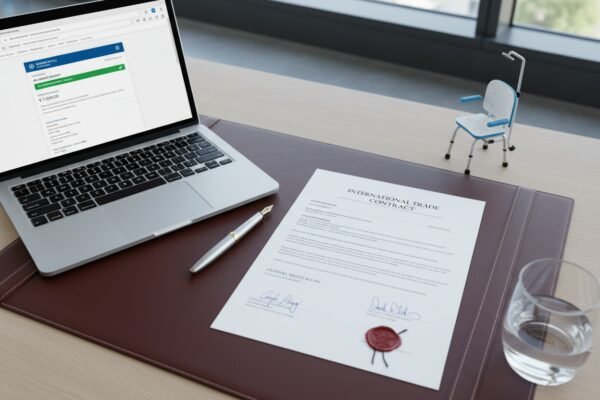
To safeguard your financial interests, use a staged payment structure such as 30% deposit with 70% due before shipment or against documents, include a clear dispute resolution clause specifying arbitration jurisdiction and governing law, and retain the right to withhold final payment pending satisfactory inspection results.
Common Payment Structures in International Trade
Payment terms for aluminum shower chairs in B2B trade vary depending on the relationship, order size, and risk tolerance. Here are the most common structures:
| Payment Structure | Buyer Risk Level | Supplier Risk Level | Best For |
|---|---|---|---|
| 100% T/T in advance | High | Low | Small first orders, new suppliers |
| 30/70 (30% deposit, 70% before shipment) | Medium | Medium | Standard repeat orders |
| Letter of Credit 9 (L/C) | Low | Low | Large orders, new relationships |
| Open Account (Net 30/60) | Low | High | Established, trusted partnerships |
| 30/70 against documents | Medium-Low | Medium | Mid-size orders with inspection rights |
For most buyers purchasing aluminum shower chairs, the 30/70 structure offers a reasonable balance. The deposit secures production capacity, and the final payment is held until the buyer confirms the goods are ready. A letter of credit adds bank-level security but involves higher administrative costs.
Linking Payment to Inspection Results
One of the strongest protections a buyer can build into a contract is tying the final payment release to inspection results. This means the 70% balance is not due until a third-party inspector confirms the goods meet the agreed specifications.
This approach works because it gives the buyer leverage without being unfair to the supplier. The supplier still receives the deposit to cover material and labor costs. The buyer gets assurance that they are not paying full price for goods they have not verified.
The contract should specify:
- Which inspection agency is authorized
- The inspection criteria and pass/fail thresholds
- The timeline for inspection after production completion (e.g., within 5 business days)
- What happens if the goods fail — rework, replacement, or partial refund
Dispute Resolution: Arbitration vs. Litigation
When things go wrong, the dispute resolution clause determines how the problem gets solved. There are two main options:
Arbitration is usually faster, more private, and more enforceable across borders. For international trade in aluminum shower chairs, arbitration through bodies like the China International Economic and Trade Arbitration Commission (CIETAC) or the International Chamber of Commerce (ICC) is common. Arbitration awards are enforceable in over 160 countries under the New York Convention 10.
Litigation through national courts can be slower and more expensive, and court judgments from one country are often difficult to enforce in another.
For most B2B buyers, arbitration is the better choice. The contract should state:
- The arbitration body (e.g., CIETAC, ICC, SIAC)
- The seat of arbitration (the city where proceedings will be held)
- The governing law (which country's law applies to the contract)
- The language of arbitration
- Whether the arbitration award is final and binding
Protecting Against Currency and Banking Risks
International payments for shower chairs are typically made in USD, EUR, or RMB. The contract should specify the currency and state whether exchange rate fluctuations are absorbed by the buyer, the supplier, or shared. It should also name the receiving bank and account details to prevent payment fraud.
Wire transfer fraud is a real risk in international trade. Buyers should verify bank details through a separate communication channel (such as a phone call) before sending any payment. The contract can include a clause requiring the supplier to confirm bank details in writing and to notify the buyer immediately if account information changes.
Retention and Holdback Clauses
For larger orders or ongoing supply agreements, buyers can negotiate a retention clause — holding back 5–10% of the total payment for 30–90 days after delivery. This retained amount serves as a guarantee against hidden defects that only appear after the chairs are unpacked, assembled, and put into use.
Retention clauses are common in construction and equipment procurement, and they work well for medical equipment like shower chairs where defects may not be visible until the product is used in a wet environment over several weeks.
Conclusion
Strong contract terms are not about distrust — they are about clarity. When quality standards, warranties, delivery penalties, and payment structures are written down precisely, both buyer and supplier can work together with confidence and fewer surprises."
Footnotes
1. Replaced with a category page for shower chairs from a medical supply website. ↩︎
2. Replaced with a working article from the same domain providing an overview and definition of industry standards. ↩︎
3. Details common aluminum alloy grades, their properties, and industrial applications. ↩︎
4. Defines AQL and its role in quality control for product inspection. ↩︎
5. Explains the purpose and benefits of third-party inspections in global trade. ↩︎
6. Describes the ASTM B117 salt spray test for assessing corrosion resistance of materials. ↩︎
7. Discusses key elements of effective warranty clauses in contracts. ↩︎
8. Explains force majeure clauses, their purpose, and common events covered in contracts. ↩︎
9. Defines a letter of credit and its function in international trade to guarantee payment. ↩︎
10. Replaced with the official UNCITRAL page for the New York Convention, which is now accessible. ↩︎