
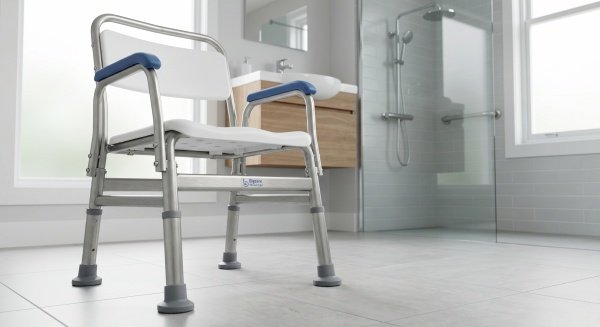
Every year, our team handles dozens of shower chair orders where the buyer later tells us the first batch they sourced elsewhere caused complaints — wobbly legs, uncomfortable seats, or armrests that blocked wheelchair transfers non-slip feet 2.
The most important ergonomic details in an aluminum shower chair are adjustable seat height, contoured seat shape with drainage, a supportive backrest angle, non-slip feet, and properly placed armrests. These features work together to reduce fall risk, ease transfers, and keep users comfortable during bathing.
Below, we break down each design detail so you can evaluate your next shower chair purchase with confidence 90 degrees 3. Let’s start with the foundation: seat height and armrest adjustments.
How Do I Determine Which Seat Height and Armrest Adjustments Are Essential for My Facility?
When we ship shower chairs to rehab centers and nursing homes across Europe, the most common feedback we get is about height mismatches — chairs set too low for tall patients or too high for shorter users.
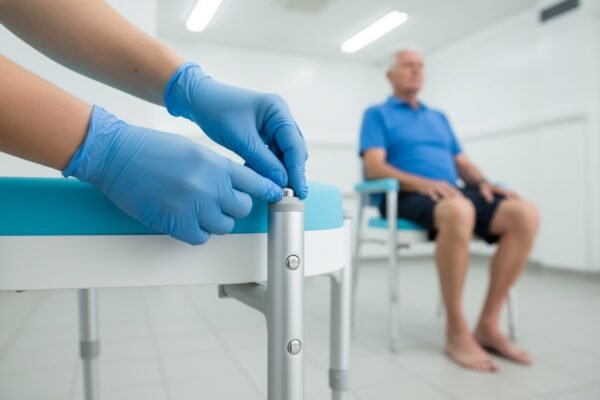
The essential seat height range for most facilities is 15 to 21 inches, adjustable in 1-inch increments, so users can sit with feet flat on the floor and knees at roughly 90 degrees. Armrests should be height-adjustable or removable to accommodate both independent and assisted transfers.
Why Seat Height Matters So Much
Seat height directly affects three things: posture, transfer safety, and user confidence. When the seat is at the right height, the user’s hips and knees form a natural angle. Their weight stays centered. Their feet grip the floor. Standing up becomes easier because the legs don’t have to work against an extreme bend.
A seat that is too low forces deep knee flexion 4. This makes standing up harder, especially for elderly users or post-surgical patients. A seat that is too high lifts the feet off the floor. The user feels unsteady and may slide forward.
How to Choose the Right Height Range
Most adult users need a seat height between 16 and 20 inches. But facilities serve a wide range of body types. That is why adjustable legs are not optional — they are essential.
Here is a quick reference:
| User Height | Recommended Seat Height | Key Concern |
|---|---|---|
| Under 5’2″” | 15–17 inches | Feet must reach the floor firmly |
| 5’2″” – 5’10″” | 17–19 inches | Knees at 90° for easy stand-up |
| Over 5’10″” | 19–21 inches | Avoid excessive knee bend |
Look for clearly marked height increments on the chair legs. Push-button or pin-lock mechanisms are the most reliable. Twist-lock systems can slip when wet if not tightened properly.
Armrest Adjustments: More Than Comfort
Armrests serve two purposes. First, they give users a stable push-off point when sitting down or standing up. Second, they provide lateral support 5 so the user feels contained and oriented in the chair.
But not all armrests help every user. Fixed, full-length armrests can block side transfers from a wheelchair. Armrests that are too high force the shoulders into an unnatural shrug. Armrests that are too low offer no real support.
| Armrest Type | Best For | Limitation |
|---|---|---|
| Fixed full-length | Independent bathers needing push-off support | Blocks side transfers |
| Swing-away / removable | Wheelchair users, assisted transfers | May feel less secure for some users |
| Height-adjustable | Mixed-use facilities with varied users | Slightly higher cost |
| Padded | Users who lean on arms frequently | Padding must dry quickly in wet settings |
For facilities that serve multiple patient types, swing-away or removable armrests offer the most flexibility. Our production team often recommends this configuration for hospital and rehab orders because it covers the widest range of transfer scenarios.
Locking Mechanisms Matter
Adjustability only helps if the chair stays locked during use. We test every locking pin and push-button mechanism under load before shipping. A chair that shifts height mid-shower is a fall waiting to happen. Ask your supplier how the locking system performs after repeated wet use and cleaning cycles.
What Specific Seat Contours and Padding Materials Should I Look for to Ensure My Patients’ Comfort?
During our R&D process for new shower chair models, we spend a lot of time testing how different seat shapes feel after 10, 15, and 20 minutes of sitting — because comfort at minute one is not the same as comfort at minute fifteen.
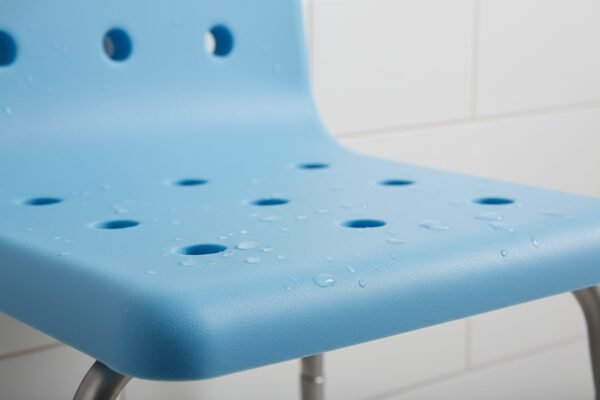
Look for seats with a gentle concave contour, rounded front edges, and drainage holes. Padding materials should be closed-cell foam or polyurethane that resists water absorption. These features distribute body weight evenly, prevent pressure buildup behind the thighs, and keep the seat hygienic in wet conditions.
Flat Seats vs. Contoured Seats
A flat seat is cheap to produce, but it concentrates pressure on the sit bones and the back of the thighs. After a few minutes, the user starts shifting to relieve discomfort. That shifting increases fall risk in a wet environment.
A contoured seat — one with a slight curve that follows the natural shape of the buttocks and thighs — spreads weight more evenly. This reduces pressure points. It also helps the user stay centered on the seat instead of sliding forward.
The Importance of Rounded Front Edges
Sharp or square front edges dig into the back of the thighs. This restricts blood flow and causes discomfort quickly. Rounded front edges let the thighs rest naturally without compression. This is especially important for users who sit for longer showers or who have reduced sensation in their legs.
Drainage Holes: Function and Safety
Drainage holes are not just about convenience. Water pooling on the seat creates a slippery surface. When the user shifts weight or tries to stand, pooled water increases the chance of sliding. Drainage holes let water pass through, keeping the seating surface drier and safer.
Drainage also helps the chair dry faster after use. A seat that stays wet breeds bacteria and mold. For facilities that use the same chair for multiple patients, fast drying supports infection control 7.
Padding Material Comparison
Not all padding works well in wet environments. Here is what to consider:
| Padding Material | Water Resistance | Comfort Level | Hygiene | Durability |
|---|---|---|---|---|
| Closed-cell foam 8 | Excellent — does not absorb water | Good cushioning | Easy to wipe clean | High |
| Open-cell foam | Poor — absorbs and retains water | Soft but problematic when wet | Mold risk if not dried | Low in wet use |
| Polyurethane (PU) 9 | Very good | Moderate to good | Smooth surface, easy to sanitize | High |
| No padding (molded plastic) | N/A — no absorption | Depends on seat contour | Easiest to clean | Very high |
For most facility use, we recommend either closed-cell foam padding or well-contoured molded plastic seats. Open-cell foam should be avoided in shower environments because it traps moisture and becomes a hygiene liability.
Textured Surfaces for Grip
A smooth seat surface can feel slippery when wet. Light texturing on the seat — small raised patterns or a matte finish — gives the user’s skin better grip without creating rough spots that are hard to clean. This is a small detail that makes a real difference in daily use.
Some of our clients also request seats with high visual contrast — a white seat on a dark frame, for example — to help users with impaired vision locate the seating surface quickly. This is a simple design choice that improves safety at no extra cost.
How Can I Verify That the Backrest Angle and Drainage Design Provide the Best Support for My Users?
When we calibrate backrest angles on our shower chair prototypes, we test with users of different heights and trunk strength levels — because a backrest that feels supportive for one person can feel restrictive or useless for another.
To verify backrest support, check that the backrest angle keeps the user’s spine upright without pushing them forward, and that it contacts the mid-to-lower back firmly. For drainage, confirm the seat has evenly spaced holes or channels that prevent water pooling without creating pressure points under the user’s weight.
What Makes a Good Backrest Angle
The backrest should hold the user in a neutral, upright posture 10. A slight recline of about 5 to 10 degrees from vertical is usually ideal. This angle supports the lower back without forcing the user to lean too far back, which can make standing up harder.
A backrest that is too upright — perfectly vertical — can feel rigid and uncomfortable. A backrest that reclines too much encourages slouching and makes it difficult for the user to reach forward to wash.
Full Back vs. Partial Back
Full-height backrests provide more contact area and are better for users with weak core muscles or poor trunk control. They give a clear sense of security. Partial or low backrests offer less support but allow more freedom of movement for users who can sit independently.
The right choice depends on the user population. For acute care or rehab settings, full backs are usually safer. For home use by relatively mobile users, a partial back may be enough.
How to Evaluate Drainage Design
Not all drainage designs are equal. Here are the key things to check:
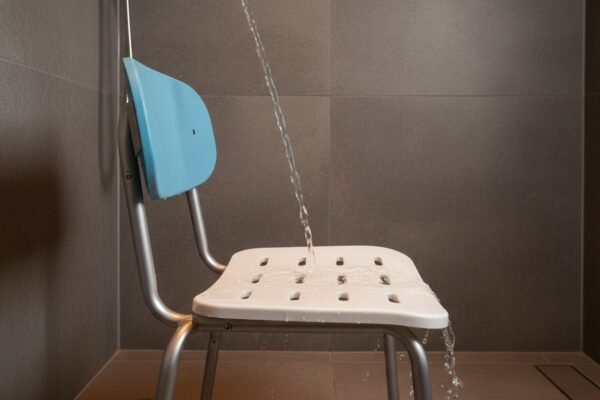
- Hole size and spacing: Holes should be large enough to let water pass through but small enough that they don’t create uncomfortable pressure points. A diameter of about 8–12 mm with even spacing works well.
- Hole placement: Holes should cover the entire seating area, not just the front or back. Water pools wherever there are no drainage paths.
- Channel drainage: Some seats use shallow channels instead of holes. Channels can move water to the edges of the seat effectively, but they must be smooth enough not to irritate skin.
- Perineal cutout: An open front or U-shaped cutout serves double duty — it improves drainage in the front area and provides easier access for personal hygiene.
Testing Drainage in Practice
The simplest test is to pour water on the seat and observe. Does it drain within a few seconds? Does any water pool in the center or near the edges? After the user sits down, does water still escape, or does body weight block the drainage holes?
We run this test on every new mold design before approving mass production. A seat that drains well when empty but traps water under load is poorly designed.
Backrest and Drainage Working Together
A good backrest keeps the user seated upright and centered. This means their weight is distributed evenly across the seat, which allows drainage holes to function properly. If the backrest pushes the user forward, they tend to sit on the front edge of the seat, concentrating weight in one area and blocking drainage in another.
So backrest angle and drainage are not separate issues. They work as a system. When evaluating a shower chair, sit in it (or have someone sit in it) and check both at the same time.
Which Handle Configurations and Frame Weights Will Make It Easiest for My Staff to Maneuver the Chair?
In our experience exporting to care facilities in North America and Europe, we hear the same concern from procurement managers: “”Our staff move these chairs dozens of times a day — if the chair is too heavy or hard to grip, it won’t get used correctly.””
The best handle configurations include molded side handles on the seat and integrated push handles on the backrest, allowing both users and caregivers to grip securely with wet hands. Frame weight should stay between 4 and 8 pounds for standard models, using aluminum alloy to balance lightness with structural stability.

Why Handle Placement Matters
Handles serve different people at different moments. The user needs handles to steady themselves while sitting down, shifting position, or standing up. The caregiver needs handles to lift, carry, and position the chair.
Molded handles built into the seat sides give the user a natural grip point at hip level. These should be slightly textured or contoured so wet hands don’t slip. Smooth, round handles are harder to grip when soapy.
Push handles on the backrest frame let caregivers move the chair without bending down. This reduces back strain for staff who reposition chairs repeatedly throughout a shift.
Handle Types and Their Uses
| Handle Type | Location | Primary User | Advantage |
|---|---|---|---|
| Molded seat handles | Sides of seat | Bather | Low, stable grip for sit-to-stand |
| Backrest push handles | Top of backrest | Caregiver | Easy to lift and reposition chair |
| Integrated armrest grips | End of armrests | Bather | Push-off support during transfers |
| Cutout handholds | Within seat surface | Bather | Discreet, no protrusion |
The best shower chairs combine at least two of these handle types. A chair with only armrest grips but no backrest handles is harder for staff to move. A chair with only backrest handles but no seat-level grips gives the user less support during transfers.
Frame Weight: The Balance Between Light and Stable
Aluminum is the preferred frame material for shower chairs because it is light, strong, and corrosion-resistant. But “”lightweight”” does not mean “”as light as possible.”” A chair that is too light can feel flimsy and may shift on the floor when the user sits down or stands up.
The sweet spot for most standard shower chairs is 4 to 8 pounds. At this weight, a caregiver can lift the chair with one hand, carry it to the shower, and set it down without strain. The chair is still heavy enough to feel planted when loaded with a user.
For bariatric models, frame weight naturally increases because the frame tubes are thicker and the seat is wider. A bariatric shower chair may weigh 10 to 15 pounds. This is still manageable for most staff, but it is worth checking whether your team can handle it comfortably during busy shifts.
Non-Slip Feet and Floor Contact
Even the lightest, best-handled chair is unsafe if it slides on wet tile. Non-slip rubber feet or suction-cup tips are essential. Rubber feet with a wide base provide friction on smooth surfaces. Suction cups add extra grip but can be harder to reposition quickly.
Cross-braced frames — where diagonal supports connect the legs — add rigidity without adding much weight. This prevents the frame from flexing when the user shifts weight, which is a common cause of instability in cheaper designs.
Tool-Free Assembly and Disassembly
An often-overlooked ergonomic feature for staff is how easy the chair is to take apart. Chairs that disassemble without tools are easier to clean thoroughly, transport between rooms, and store compactly. Push-button leg removal and snap-on backrests save time and reduce the chance of incorrect reassembly.
When we design new models, we aim for assembly that takes under two minutes with no tools. This matters because a chair that is difficult to configure often ends up being used in the wrong setup — wrong height, missing backrest, or loose armrests — which defeats the purpose of ergonomic design.
Antimicrobial Considerations
More facilities now ask for frames and seats with antimicrobial protection. Coatings like Microban-style treatments inhibit bacterial growth on surfaces between cleanings. This does not replace proper sanitation, but it adds a layer of hygiene protection in high-turnover environments. When combined with fast-draining seats and smooth, easy-to-wipe surfaces, antimicrobial coatings help keep the chair safe for the next user.
Conclusion
Ergonomic design in aluminum shower chairs is not about adding more features. It is about matching the right seat height, contour, backrest, handles, and frame weight to your users’ real needs — so every shower is safer and more comfortable.”
Footnotes
1. Explains core principles of ergonomic design for products. ↩︎
2. Explains ASTM standards for slip resistance, crucial for safety on wet surfaces. ↩︎
3. Provides ergonomic recommendations for proper knee angle in sitting posture. ↩︎
4. Discusses importance of proper knee angle to avoid pressure and stiffness. ↩︎
5. Explains how lateral supports improve posture and stability in seating. ↩︎
6. Details medical necessity and benefits of adjustable seat height in mobility aids. ↩︎
7. Replaced HTTP 404 with an authoritative CDC guidelines library for infection control. ↩︎
8. Describes properties of closed-cell foam, including water resistance and durability. ↩︎
9. Replaced HTTP 404 with a detailed resource on polyurethane properties and advantages. ↩︎
10. Explains benefits of maintaining a neutral posture for minimizing stress and injury. ↩︎