

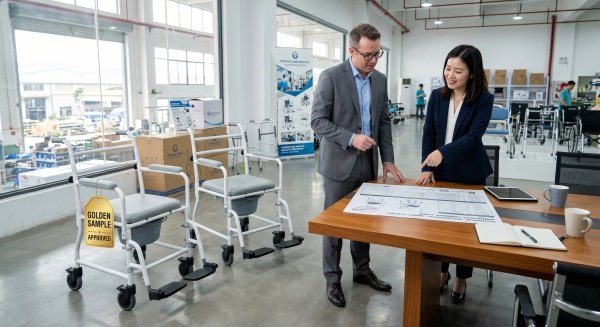
We often see buyers struggle when mass-produced commode chairs fail to match the prototype. This inconsistency causes severe delays. Establishing a strict sample approval process solves this problem entirely.
To ensure mass production matches your mobile commode chair sample, you must establish a formal golden sample policy, create an extremely detailed technical specification sheet, verify factory production capabilities beforehand, and conduct strict pre-shipment quality control using third-party or internal inspections.
Let us explore the essential steps you need to take to maintain strict quality control 1 and protect your medical equipment supply chain.
How can I ensure the materials used in mass production match the quality of my initial commode chair sample?
Discovering cheap steel substituted for premium materials on the assembly line is a common nightmare. Our production team knows this ruins product safety. You need strict material verification protocols.
You can ensure material consistency by requiring raw material certificates, conducting random lab testing for metal grades, and strictly defining material tolerances in your purchase contract before mass production begins.

When you source mobile commode chairs from China, you must remember that material substitution is a hidden risk. A factory might use premium aluminum for your sample but switch to a cheaper alloy for the bulk order. To prevent this, you must build material verification into your sourcing process.
Evaluate In-House Manufacturing Capabilities
First, you need to understand your supplier’s true capabilities. Many quality issues arise when a factory outsources parts of the production process. If a factory outsources frame welding or plastic injection molding, they lose direct control over material consistency. We always invite our clients to audit our production lines. You should ask your supplier to prove they have a robust Quality Management System 2 in place. Look for compliance with NMPA Good Manufacturing Practices 3 or ISO 13485 standards 4. This ensures they follow structured quality oversight.
Implement Strict Material Traceability
Next, demand clear documentation for all raw materials. You should ask the factory to provide material certificates from their steel or aluminum suppliers. If the chair uses specific plastics for the seat or bucket, ask for the resin data sheets. Some forward-thinking buyers even require blockchain technology ledgers for material traceability 5. This creates an immutable record of raw material origins, guaranteeing that mass production uses the exact same grade as the approved sample.
Conduct Independent Lab Testing
Finally, do not rely on visual inspection alone to verify materials. You cannot see the difference between two similar grades of steel just by looking at them. You must conduct independent lab testing. Send a piece of the mass-produced frame to a NMPA-designated laboratory. They can verify the metal grade, test the tensile strength, and check the corrosion resistance of the powder coating.
Material Verification Strategies
| Verification Method | Primary Purpose | Cost Level | Reliability |
|---|---|---|---|
| Visual Inspection | Checks cosmetic finish and basic structure | Low | Moderate |
| Material Certificates | Verifies raw material origin and grade | Low | High |
| Independent Lab Testing | Confirms metal strength and chemical composition | High | Very High |
| Digital Traceability | Tracks materials from mill to assembly line | High | Very High |
What specific technical details should I include in my specification sheet to prevent quality fade?
Vague instructions always lead to unwanted manufacturing surprises. When our engineers receive unclear specifications, it forces guesswork and causes errors. You must document every critical product detail clearly.
Your specification sheet must detail frame tube thickness, precise material grades, exact dimensions for seats and buckets, caster wheel locking mechanisms, welding standards, and specific powder coating or chrome finish requirements.
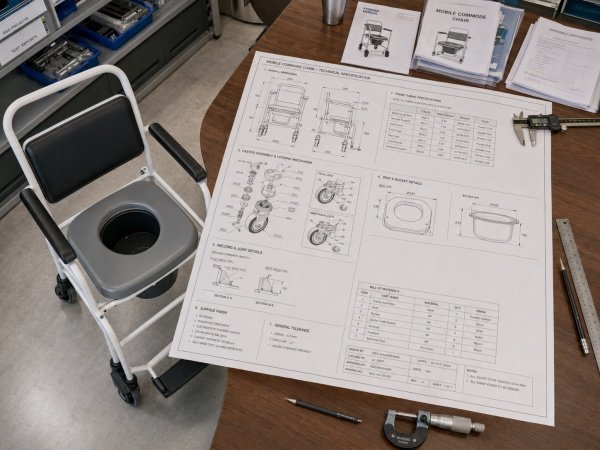
A mobile commode chair sits at the intersection of medical equipment and daily furniture. Because of this, your technical specification sheet 6 must be flawless. If you leave any detail open to interpretation, the factory will naturally choose the easiest or cheapest option during mass production.
Define Frame and Structural Details
The frame is the most critical part of the chair. You must clearly state the exact material. Do not just write “aluminum.” You must specify the alloy grade. Next, list the exact tube diameter and wall thickness. A small reduction in tube thickness can drastically lower the maximum weight capacity of the chair. You must state the required maximum load rating explicitly. Additionally, outline the required welding standards. Specify whether the welds should be ground smooth or left visible, as this affects both aesthetics and safety.
Specify Surface Finishes and Fasteners
Because these chairs are used in bathrooms, rust prevention is crucial. You need to detail the surface finish requirements. If you want a powder coating, specify the coating thickness and the required salt spray test duration. If you use chrome, define the plating standards. Furthermore, do not ignore the small hardware. State that all screws, nuts, and bolts must be made of stainless steel. Cheaper carbon steel fasteners will rust quickly in a humid environment.
Detail the Casters and Accessories
The casters handle a lot of stress. Your specification sheet must detail the caster size, the wheel material, and the locking mechanism. Specify if you need dual-locking casters that stop both the wheel rotation and the swivel. Finally, define the exact dimensions for the seat opening and the bucket. The bucket must fit securely under the seat without rattling.
Essential Commode Chair Specifications
| Component Category | Key Details to Specify in Document | Common Failure Risk |
|---|---|---|
| Main Frame | Metal grade, tube diameter, wall thickness | Structural bending or breaking |
| Surface Finish | Coating type, thickness, rust resistance | Peeling paint or rapid corrosion |
| Caster Wheels | Wheel diameter, material, locking type | Unstable movement or broken brakes |
| Seat and Bucket | Cushion material, exact dimensions, lid fit | Discomfort or unhygienic leaks |
How do I effectively use a golden sample to conduct quality control inspections at the factory?
Storing an unapproved sample in a random corner helps no one. Our quality inspectors know that unverified changes ruin product safety. You must implement a formal benchmark strategy.
You must sign and date the approved prototype, store it securely at the factory as the absolute benchmark, and mandate that all final inspections compare random bulk units directly against this golden sample.
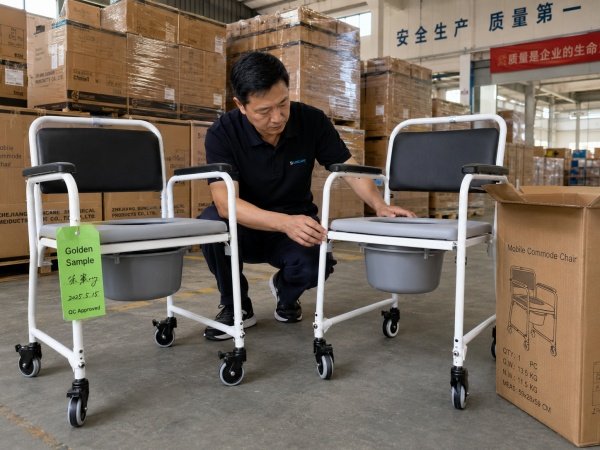
The term “golden sample 7” refers to the final, perfect prototype that both the buyer and the manufacturer agree represents the exact standard for mass production. For load-bearing products like mobile commode chairs, you cannot simply rely on memory or photos. You need a physical benchmark.
Establish the Golden Sample Protocol
Once you approve a sample, you must formalize it immediately. Sign the chair with a permanent marker, attach a signed tag, and date it. You should then store this golden sample in a secure location at the factory. It should only be taken out for pre-production meetings and final inspections. Alongside the physical chair, you must create a digital twin. Take high-resolution photos and videos of every angle, weld, and moving part. Upload these to a shared cloud folder so your inspection team can access them easily.
Implement Pre-Production Alignment
Before the assembly line starts running, require the factory to hold a pre-production meeting. During this meeting, the factory managers must show the golden sample to the assembly line leaders. They must review every critical point, including the raw materials, the finish quality, and the caster installation. This ensures that the workers understand exactly what standard they must meet.
Execute Final Quality Control
When the bulk order is ready, your third-party inspector must use the golden sample. They should place a random mass-produced chair right next to the golden sample. The inspector needs to check the frame alignment, the seat fit, and the bucket placement. They must also perform functional testing. This includes static load testing and checking the caster braking performance under weight. Recently, some factories have even started using AI-powered visual inspection systems on the line to catch subtle cosmetic inconsistencies automatically.
QC Inspection Checklist
| Inspection Area | Specific Action Required | Golden Sample Comparison |
|---|---|---|
| Visual Appearance | Check paint finish and weld smoothness | Must match the approved finish exactly |
| Dimensional Accuracy | Measure frame height, width, and seat size | Must be within defined tolerances |
| Functional Testing | Apply weight and test caster brakes | Brakes must hold as firmly as the sample |
| Component Fit | Insert and remove the commode bucket | Bucket must slide smoothly without gaps |
What steps should I take if the final shipment of commode chairs doesn’t meet the standards of my approved prototype?
Discovering defects right before shipping creates intense pressure for buyers. In our daily export operations, we know mishandling this damages trust. You must address inspection failures methodically.
If the shipment fails inspection, you must immediately halt shipping, demand a detailed defect report, require the factory to rework or replace the faulty units, and enforce a re-inspection before any final payment.
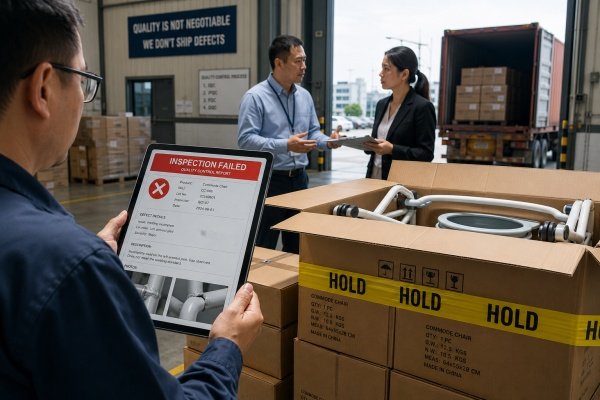
No buyer wants to receive a failed inspection report, but it happens. When a bulk order of mobile commode chairs deviates from the golden sample, your immediate actions dictate the final outcome. Panic or hasty decisions will lead to accepting bad inventory. You need a structured approach to resolve the discrepancies and protect your investment.
Halt the Shipment Immediately
The moment your inspector identifies critical deviations, you must stop the shipment. Do not let the factory load the containers. Once the goods are on the ocean, you lose all your negotiating power. Instruct your third-party inspector to thoroughly document the failures. They need to take clear photos and videos showing exactly how the bulk units differ from the golden sample. If the issue is serious, ask the inspector to pull more units to see if the defect affects the entire batch or just a few cartons.
Categorize the Production Defects
Not all defects require a complete remake. You need to categorize the problems. Minor cosmetic issues, like a tiny scratch on a hidden tube, might be acceptable if you are pressed for time. However, structural deviations are unacceptable. If the factory used weaker casters, poor welding, or materials that rust easily, you cannot compromise. These are safety hazards. You must communicate clearly with the factory management, separating minor flaws from major safety failures.
Implement Corrective Actions
Once you categorize the defects, you must demand solutions. For easily replaceable parts, like wrong buckets or loose armrests, the factory can simply swap the components. For major structural flaws, the factory must remake the affected units at their own expense. Finally, you must require a Corrective and Preventive Action report 8. This document forces the factory to explain why the error happened and how they will prevent it during your next order. Always conduct a full re-inspection after the rework is done.
Defect Severity Classification
| Defect Category | Description | Required Action |
|---|---|---|
| Minor Defect | Small cosmetic scratches, slight label misalignment | Request discount or accept if urgent |
| Major Defect | Incorrect dimensions, missing accessories | Require immediate rework or part swapping |
| Critical Defect | Weak welding, unstable casters, failed load test | Reject entire batch, demand full replacement |
| Documentation Error | Wrong carton marks, missing user manuals | Pause shipment until paperwork is fixed |
Conclusion
Securing reliable mobile commode chairs requires precise specifications and strict sample control. By taking these steps, you protect your business from costly defects and ensure total patient safety.
Footnotes
1. Explains the importance of rigorous checks to ensure product standards. ↩︎
2. Defines a formalized system for achieving quality policies and objectives. ↩︎
3. Details the regulatory requirements for medical device manufacturing in China. ↩︎
4. Explains the international standard for medical device quality management systems. ↩︎
5. Explains the process of tracking raw materials through the supply chain. ↩︎
6. Describes a document detailing requirements for a material, design, or product. ↩︎
7. Explains the concept of a benchmark prototype for mass production quality. ↩︎
8. Defines a formal document for addressing and preventing quality non-conformities. ↩︎