
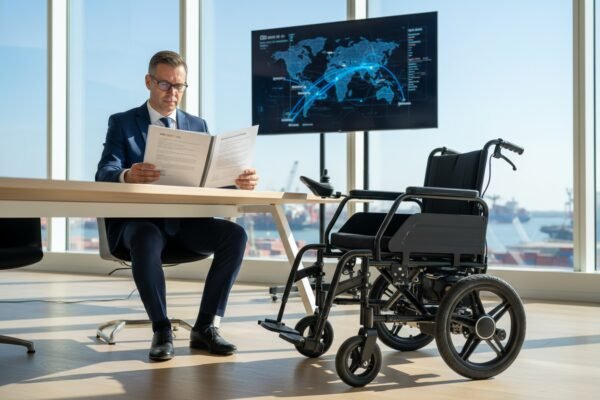
Every year, our team in Foshan handles dozens of inquiries from European distributors who are confused about what paperwork they actually need before importing electric wheelchairs into the EU.
Electric wheelchairs exported to the EU must comply with the Medical Device Regulation (EU) 2017/745 (MDR). Depending on classification (Class I or Class IIa), you need CE marking, a Declaration of Conformity, technical documentation, EN 12184 test reports, ISO 13485 certification, and UDI registration in EUDAMED.
Getting this wrong can mean a €50,000 shipment stuck at Rotterdam port. Below, we break down each requirement so you can source with confidence and avoid costly delays.
How do I know if my Chinese electric wheelchair supplier meets the latest EU MDR standards?
When we first started exporting to European markets years ago, the old MDD rules felt straightforward. But since MDR took full effect in 2021, the compliance landscape has changed dramatically for everyone involved.
To verify MDR compliance, request your supplier's CE marking documentation issued under MDR (EU) 2017/745 — not the old MDD 93/42/EEC. Confirm they hold a valid ISO 13485 certificate, have a registered Single Registration Number (SRN), and can provide EN 12184 test reports from an accredited lab.

Understanding the Shift from MDD to MDR
The old Medical Device Directive (MDD 93/42/EEC) 1 was replaced by MDR (EU) 2017/745. This is not just a name change. MDR demands more rigorous clinical evaluations, tighter post-market surveillance, and full traceability through the Unique Device Identification (UDI) system 2. If your supplier still references MDD on their Declaration of Conformity, that is an immediate red flag.
Many Chinese suppliers updated their documentation between 2021 and 2024. But in our experience working with buyers across Europe, we still see outdated MDD certificates circulating on Alibaba listings. Always check the regulation reference number on the DoC itself.
Class I vs. Class IIa: Why It Matters
The classification of your electric wheelchair determines the entire certification pathway. This is where confusion often arises.
| Feature | Class I | Class IIa |
|---|---|---|
| Typical product | Basic powered wheelchair, low speed | Powered wheelchair with advanced controls, higher speed |
| Notified Body 3 required? | No — self-declaration | Yes — must audit technical file 4 |
| Speed threshold (general guidance) | ≤ 6 km/h | > 6 km/h or complex features |
| Conformity assessment | Annexes IV + internal checks | Annexes IV + Notified Body review |
| CE mark 5ing route | Manufacturer self-certifies | NB issues certificate first |
Some importers assume all electric wheelchairs are Class I. This is risky. Under MDR Annex VIII 6, powered models with higher speeds, tilt-in-space functions, or electronic control systems often fall into Class IIa. The consequence? You need a Notified Body to review your technical file before you can legally affix the CE mark. Skipping this step can lead to seizure at customs and fines up to €100,000.
Quick Supplier Vetting Steps
From our production floor, we recommend buyers follow this sequence:
- Ask for the DoC and check it references MDR (EU) 2017/745 7.
- Verify the supplier's ISO 13485 certificate on the registrar's website.
- If the product is Class IIa, confirm the Notified Body number and cross-check it on the NANDO database.
- Request the SRN and look it up once EUDAMED's actor registration module is live.
- Ask for EN 12184 test reports and confirm the testing lab is accredited.
If a supplier cannot produce these within a few business days, consider that a warning sign.
Which specific certificates and technical files must I request from my manufacturer to avoid customs issues?
Our export team has seen shipments held at European ports simply because one document was missing or referenced the wrong regulation. The paperwork requirements under MDR are detailed and specific.
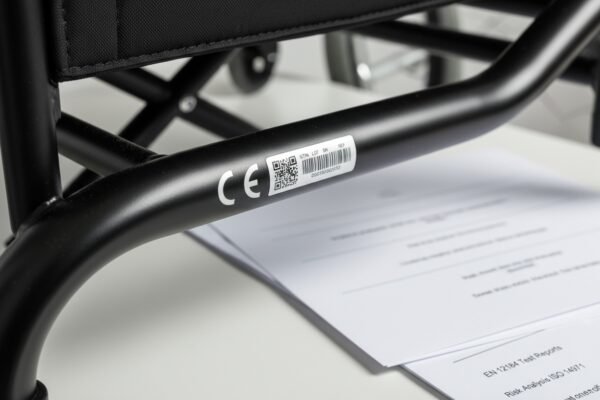
You must request an MDR-compliant Declaration of Conformity, the full technical file (including risk analysis per ISO 14971, design files, and clinical evaluation), EN 12184 and EN 60601-1 test reports, ISO 13485 certificate, UDI labels, and — for Class IIa products — a Notified Body certificate verifiable in NANDO.
The Complete Document Checklist
Below is a practical table we share with our European buyers before every order. It lists each required document, its purpose, and how to verify it.
| Document | Purpose | How to Verify | Common Problem |
|---|---|---|---|
| Declaration of Conformity (DoC) | Legal statement of MDR compliance | Cross-check in EUDAMED | References old MDD instead of MDR |
| Technical File | Full design, risk, and clinical documentation | Review completeness against MDR Annex II/III | Missing clinical evaluation or risk analysis |
| EN 12184 Test Report | Safety and performance for powered wheelchairs | Check accredited lab stamp (e.g., TÜV, SGS) | No battery or EMC test sections included |
| EN 60601-1 Test Report | Electrical safety for medical equipment | Accredited lab verification | Outdated edition referenced |
| ISO 13485 Certificate | Quality Management System proof | Registrar's online database | Expired or scope too narrow for wheelchairs |
| Notified Body Certificate (Class IIa) | Third-party conformity audit | NANDO database — match NB number and scope | Wrong or fabricated NB number |
| UDI Label + EUDAMED Registration | Traceability and market surveillance | EUDAMED device lookup | Missing, unreadable, or not registered |
| ISO 14971 Risk Analysis | Systematic risk management | Included in technical file | Generic template not specific to the device |
| UN38.3 (if lithium battery) | Battery transport safety | Test lab certificate | Missing for lithium-ion batteries |
What Goes Inside the Technical File?
The technical file is not a single document. It is a collection. Under MDR Annex II and III, it must include:
- Device description and specifications (including all variants).
- Design and manufacturing information with drawings.
- General safety and performance requirements checklist (MDR Annex I).
- Risk management file per ISO 14971.
- Clinical evaluation report — even for Class I devices.
- Labeling and instructions for use in the language of the destination country.
- Post-market surveillance plan.
When we prepare technical files in our Foshan facility, we work with third-party regulatory consultants to make sure nothing is missed. A gap in the clinical evaluation section alone can delay your customs clearance by weeks.
The UDI Requirement
The Unique Device Identification system is relatively new and trips up many importers. Every electric wheelchair must carry a UDI on its label. This UDI consists of a Device Identifier (DI) and a Production Identifier (PI). The DI must be registered in EUDAMED 8. Without it, EU customs authorities have grounds to hold your shipment.
We laser-etch UDI codes onto our wheelchair frames and print them on packaging. If your supplier does not mention UDI at all, that is a serious concern.
Can I still get MDR certification if I customize the colors and features of my electric wheelchairs?
Many of our buyers — like distributors in Spain, Germany, and the Netherlands — want custom frame colors, branded joystick covers, or modified seat dimensions. This is a common question we hear on nearly every OEM call.
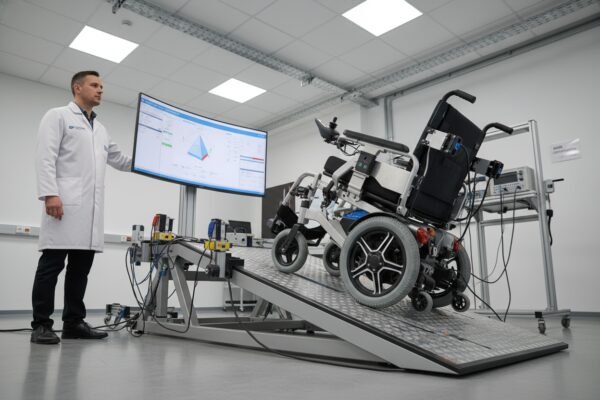
Yes, you can customize colors and features and still achieve MDR certification. However, each significant design change — such as new electronic components, altered frame geometry, or different battery types — may require updated risk analysis, additional testing under EN 12184, and amendments to the technical file and Declaration of Conformity.
Cosmetic Changes vs. Functional Changes
Not all customizations are treated equally under MDR. The key distinction is whether the change affects the safety or performance of the device.
Cosmetic changes — like a new powder coat color, custom upholstery fabric, or branded decals — generally do not trigger a new conformity assessment. They are considered variants of the same device. However, they must still be documented in the technical file as design variants.
Functional changes are different. If you swap the joystick controller, upgrade the motor, change the battery chemistry (e.g., from lead-acid to lithium-ion), or alter the maximum speed, these modifications can affect classification, risk profile, and test results. Each functional change needs:
- Updated risk analysis (ISO 14971).
- New or supplemental EN 12184 testing for affected parameters (braking distance changes with a new motor, for example).
- Revised clinical evaluation if the intended use or risk profile shifts.
- Updated DoC and, for Class IIa, possible re-engagement with the Notified Body.
Practical Examples from Our Production Line
On our factory floor in Foshan, we handle OEM customization daily. Here is how we categorize common requests:
| Customization Request | Type | MDR Impact | Action Required |
|---|---|---|---|
| Change frame color from black to red | Cosmetic | Minimal | Update technical file variant list |
| Add branded logo to joystick | Cosmetic | Minimal | Update labeling section in technical file |
| Switch from lead-acid to lithium battery | Functional | Significant | New UN38.3 test, updated risk analysis, revised EN 12184 battery tests |
| Increase max speed from 6 km/h to 10 km/h | Functional | Major — may change classification | Possible reclassification to Class IIa, Notified Body review required |
| Change seat width from 45 cm to 50 cm | Functional (minor) | Moderate | Updated stability testing per EN 12184, revised technical file |
| Add Bluetooth connectivity module | Functional | Significant | Cybersecurity risk assessment, EMC retesting, updated technical file |
How to Keep Costs Down
Our advice to buyers: group your customizations before the certification process begins. Making changes after the Notified Body has reviewed your technical file means additional review fees. If you plan multiple SKUs with different colors and seat sizes, submit them all as variants in a single technical file. This is far cheaper than treating each as a separate device.
We also recommend working with your supplier's regulatory team early. At our facility, we include regulatory planning in the OEM quotation phase so buyers know the full cost upfront — no surprises after production starts.
How do I verify that the MDR documentation provided by my Foshan supplier is authentic and up to date?
We have heard stories from buyers who received impressive-looking certificates, only to discover during an EU customs audit that the Notified Body number was fabricated. Verification is not optional — it is essential to protect your business.
Verify MDR documentation by cross-referencing the Notified Body certificate number in the EU's NANDO database, checking the supplier's ISO 13485 certificate on the issuing registrar's website, confirming UDI registration in EUDAMED, and validating the Single Registration Number (SRN) once EUDAMED's full modules are operational.
Step-by-Step Verification Process
Do not rely on PDFs alone. Here is the workflow our European partners follow:
Step 1: Check the Declaration of Conformity. The DoC should reference MDR (EU) 2017/745, list the device name and model, include the manufacturer's address, state the classification, reference applicable harmonized standards (EN 12184, EN 60601-1), and be signed and dated. If it references Directive 93/42/EEC, it is an MDD-era document and no longer valid for new products.
Step 2: Verify the Notified Body. For Class IIa devices, the DoC and CE certificate will include a four-digit Notified Body number. Go to the European Commission's NANDO database (ec.europa.eu/growth/tools-databases/nando). Search the NB number. Confirm:
- The NB is designated for MDR (EU) 2017/745.
- The NB's scope covers the relevant device category.
- The NB's designation is current and not suspended.
Step 3: Validate ISO 13485. Ask your supplier for the certificate number and the name of the certification body. Major registrars like TÜV, BSI, and SGS have online verification portals. Check that the certificate is current, the scope mentions electric wheelchairs or powered mobility devices, and the manufacturer's legal name and address match.
Step 4: Confirm UDI in EUDAMED. As EUDAMED modules roll out (phased through 2026), you can look up device identifiers. If the DI is not registered, the product technically cannot be sold in the EU.
Step 5: Conduct a Pre-Shipment Audit. For high-value orders, we recommend hiring a third-party inspection firm like SGS China, Bureau Veritas, or TÜV Rheinland to visit the factory. They can verify the QMS in operation, confirm production matches the technical file, and check that UDI labels are correctly applied.
Red Flags to Watch For
Here are warning signs we have seen in our industry:
- The supplier refuses to share the full technical file or says it is "confidential." Under MDR, the economic operator (you, the importer) has obligations to verify compliance.
- The Notified Body number does not appear in NANDO or appears with a different scope.
- The ISO 13485 certificate expired months ago.
- Test reports come from labs you cannot find in any accreditation database.
- The supplier claims EUDAMED registration but cannot provide the SRN or DI code.
- Documents contain inconsistent dates, manufacturer names, or addresses.
The Cost of Getting It Wrong
EU customs rejections for non-compliant medical devices have increased steadily since MDR enforcement began. Data from RAPEX shows over 15 wheelchair-related recalls per year, mostly for braking and EMC failures. A single detained shipment can cost you the goods, storage fees, return shipping, and potential fines. Some EU member states impose penalties exceeding €100,000 for placing non-compliant medical devices on the market.
Investing a few hundred euros in document verification and a pre-shipment audit can save you tens of thousands. We always encourage our partners to budget for this as part of the sourcing cost — not an afterthought.
The Role of the EU Authorized Representative and PRRC
Under MDR, if your Chinese manufacturer does not have a legal presence in the EU, they must appoint an EU Authorized Representative 9. This representative takes on legal obligations and must be listed on the device label. Additionally, MDR requires a Person Responsible for Regulatory Compliance (PRRC) 10 — someone with proven expertise in medical device regulation — to be designated within the manufacturer's or authorized representative's organization.
Ask your supplier: Who is your EU Authorized Representative? Can you provide their contact details and SRN? If they cannot answer, the MDR compliance chain is broken.
Conclusion
Sourcing MDR-compliant electric wheelchairs from China is achievable — but only when you verify every document, understand your device classification, and partner with a supplier who takes regulatory compliance seriously.
Footnotes
1. Provides the official text and scope of the former EU Medical Device Directive. ↩︎
2. Explains the EU UDI system and GS1’s role as an issuing entity. ↩︎
3. Replaced with the official NANDO database, which lists all Notified Bodies for medical devices in the EU. ↩︎
4. Details the comprehensive documentation required for a medical device technical file under MDR. ↩︎
5. Replaced with a comprehensive guide from Emergo by UL, a reputable regulatory consulting firm, explaining CE marking under EU MDR. ↩︎
6. Replaced with the direct legal text of Annex VIII of Regulation (EU) 2017/745, which outlines medical device classification rules. ↩︎
7. Official text of the current European Medical Device Regulation. ↩︎
8. Provides steps and details for registering medical devices in the EUDAMED database. ↩︎
9. Explains the essential functions and responsibilities of an EU Authorized Representative under MDR. ↩︎
10. Replaced with an authoritative page from BSI, a leading certification body, explaining the PRRC role under EU MDR/IVDR. ↩︎